Profile picture

Doctor Shingo Matsumoto

Tokai University, Tokyo (Japan)
Membership: ESC Professional Member EHRA Member
Follow
Logo ESC

Contributor content

Antifibrotic drugs: the journey to prime time
Presentation
Antifibrotic drugs: the journey to prime time
High-sensitivity cardiac troponin and the effect of finerenone in patients with heart failure and mildly reduced or preserved ejection fraction: a prespecified analysis of FINEARTS-HF
Presentation
High-sensitivity cardiac troponin and the effect of finerenone in patients with heart failure and mildly reduced or preserved ejection fraction: a prespecified analysis of FINEARTS-HF
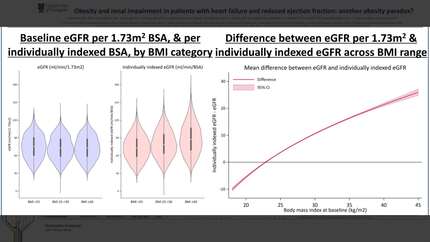
Obesity and renal impairment in patients with heart failure and reduced ejection fraction: another obesity paradox?
Presentation
Obesity and renal impairment in patients with heart failure and reduced ejection fraction: another obesity paradox?
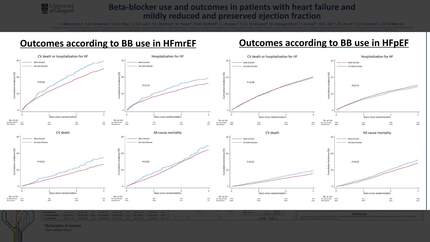
Beta-blocker use and outcomes in patients with heart failure and mildly reduced and preserved ejection fraction
Presentation
Beta-blocker use and outcomes in patients with heart failure and mildly reduced and preserved ejection fraction
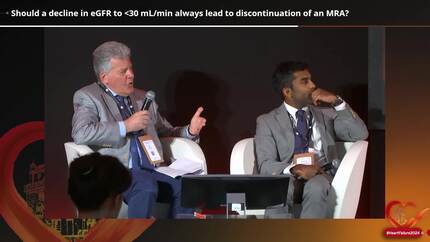
Should a decline in eGFR to <30 mL/min always lead to discontinuation of an MRA?
Presentation
Should a decline in eGFR to <30 mL/min always lead to discontinuation of an MRA?
Asymptomatic versus symptomatic hypotension in HFrEF: Findings with sacubitril/valsartan in PARADIGM-HF
Presentation
Asymptomatic versus symptomatic hypotension in HFrEF: Findings with sacubitril/valsartan in PARADIGM-HF
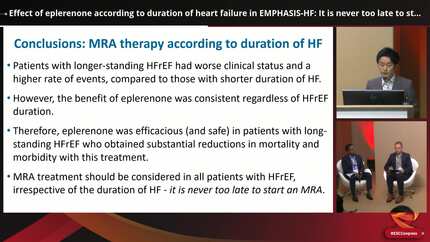
Effect of eplerenone according to duration of heart failure in EMPHASIS-HF: It is never too late to start an MRA in HFrEF
Presentation
Effect of eplerenone according to duration of heart failure in EMPHASIS-HF: It is never too late to start an MRA in HFrEF
Calcium channel blocker and outcomes in patients with heart failure and mildly reduced or preserved ejection fraction
Presentation
Calcium channel blocker and outcomes in patients with heart failure and mildly reduced or preserved ejection fraction
Lack of brain natriuretic peptide reduction at 30-day significantly predicts worse clinical outcomes in non-responders of cardiac resynchronization therapy
Presentation
Lack of brain natriuretic peptide reduction at 30-day significantly predicts worse clinical outcomes in non-responders of cardiac resynchronization therapy
Heart rate during hypothermia therapy is an independent predictor of clinical outcomes in patients resuscitated from out-of-hospital cardiac arrest due to acute coronary syndrome
Presentation
Heart rate during hypothermia therapy is an independent predictor of clinical outcomes in patients resuscitated from out-of-hospital cardiac arrest due to acute coronary syndrome

ESC 365 is supported by