
Doctor Konstantin Zavadovskiy
Cardiology Research Institute, Tomsk National Research Medical Centre, Russian Academy of Sciences, , Tomsk (Russian Federation)
Biography
Head of nuclear medicine department in Cardiology Research Institute, Tomsk National Research Medical Centre, Russian Academy of Sciences, Tomsk, Russia. Professor of Radiology Department, Siberian State Medical University, Tomsk. He has a special interest in nuclear cardiology and cardiac CT.

Contributor content
Presentation
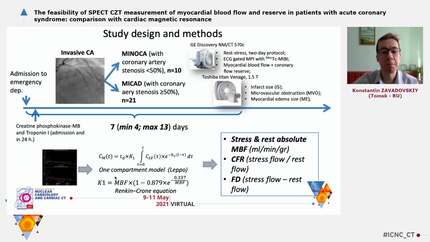
The feasibility of SPECT CZT measurement of myocardial blood flow and reserve in patients with acute coronary syndrome: comparison with cardiac magnetic resonance


Presentation
The role of stress-induced dyssynchrony obtained from nuclear modalities in evaluation of high-risk patients after surgical treatment of ischemic cardiomyopathy

Presentation
The comparison of left ventricular mechanical dyssynchrony obtained by myocardial perfusion scintigraphy and gated blood pool SPECT to predict the result of the cardiac resynchronization therapy

Presentation
Evaluation of visual and quantitative parameters of MPS SPECT in MINOCA patients in one year after acute coronary syndrome: comparison with CMR

Presentation
The detection of multivessel coronary artery disease: the value of quantitative myocardial blood flow and coronary flow reserve assessment

Presentation
Prognostic significance of cardiac sympathetic activity and dyssynchrony in response to cardiac resynchronization therapy

Presentation
The link between myocardial perfusion and integrated CT indices of atherosclerotic burden in patients with coronary artery disease
Presentation
The value of myocardial blood flow and coronary flow reserve assessment in patients with multivessel coronary artery disease
Presentation
The comparison of dynamic single photon emission computed tomography and fractional flow reserve in significant myocardial ischemia prediction
Presentation

