Ventricular-valvular-vascular coupling in patients with severe aortic stenosis: changes after surgery and prognostic significance
European Journal of Heart Failure


Abstract
Left ventricular (LV) remodeling in patients with aortic stenosis (AS) is not merely determined by the valve obstacle but also by arterial impedance on LV afterload (ventricular-valvular-vascular coupling). Valve intervention in patients with severe AS remains the standard treatment. However, its impact on the combined coupling mechanisms and their prognostic impact remains unclear.
Evaluate ventricular-valvular-vascular coupling following SAVR and to determine its prognostic role in patients with severe AS.
Single-centre, prospective cohort study of 158 patients with severe symptomatic AS (mean age 71±8 years, 50% male) referred for SAVR between 2019 and 2022. Patients with prior cardiomyopathy, significant aortic regurgitation, or other severe valve disease were excluded. All participants underwent transthoracic echocardiography (TTE) and cardiac magnetic resonance (CMR) within 3 months before and after SAVR. Valve morphology was either determined from TTE or surgical operative reports. Aortic dimensions were assessed from cine CMR images in standard views, and used to calculate aortic distensibility (AD) based on maximum and minimum aortic areas. Valvulo-arterial impedance (Zva) was also calculated from TTE, as well as the relative valve load (RVL). Changes in these parameters, their correlations, and their association with the combined endpoint of all-cause and cardiovascular mortality were analysed using Cox regression.
128 patients who completed the study were included of whom 15% had a bicuspid aortic valve (BAV). All patients had high-gradient, normal-flow, preserved LV ejection fraction severe AS.
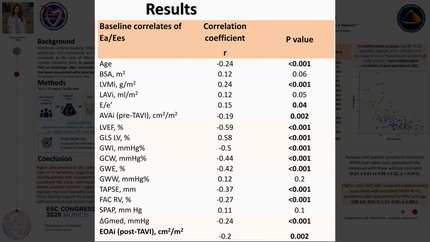
Before SAVR, valvular obstacle was the main determinant of LV afterload and AD showed weak correlations with Zva (ρ= –0.212, p=0.019). However, in subgroup analysis there was a good correlation between Zva and AD in patients with BAV (ρ–0.651, p=0.011 vs. ρ=–0.151, p=0.122 in TAV). After SAVR there was a non-significant increase in AD (1.4 [0.7–2.2] vs. 1.6 [0.8–2.4] × 10⁻³ mmHg⁻¹, p=0.328). In contrast, Zva and RVL had a significant reduction: Zva: 4.6 [3.8–5.1] vs. 3.5 [2.8–4.9]mmHg/mL/m², p=0.009; RVL: 13.5 [10.9–16.7] vs. 3.3 [2.3–4.8]mL/m², p<0.001.
At a mean follow-up of 48 ± 10 months after SAVR, the composite primary endpoint occurred in 30 patients (10 deaths). On univariate analysis, only pre-SAVR Zva and RVL were predictive of the combined outcome (Zva with superior discriminative power). No post-intervention parameter was significantly associated with the prognosis.
Valvular obstacle is the main determinant of LV afterload in patients with classical severe aortic stenosis, and its treatment has inherent impact on prognosis after surgery. AD had weak correlation with global valvulo-arterial impedance, though a stronger association between AD and Zva was observed in patient with BAV, suggesting that valve morphology may influence ventricular-valvular-vascular coupling. Before and After SAVR Outcomes
Contributors

J Abecasis
Author
K Stankowski
Author
R Barbosa
Author
S Azevedo
Author
P Lopes
Author
M Madeira
Author
M Sousa Uva
Author
A Fer
Author
R Ribeiras
Author
S Ramos
Author
P Adragao
Author
You may be interested in