Impact of residual tricuspid regurgitation after transcatheter tricuspid therapies on right and left ventricular mechanics: insights from a case series
European Heart Journal - Case Reports


Abstract
Severe tricuspid regurgitation (TR) induces right ventricular (RV) volume overload and disrupts biventricular mechanics. Tricuspid transcatheter edge-to-edge repair (T-TEER) and transcatheter tricuspid valve replacement (TTVR) are effective strategies to reduce or eliminate TR, yet their immediate physiological effects and the impact of residual TR remain incompletely characterized. We used invasive pressure-volume (PV) analysis to assess acute biventricular responses to transcatheter tricuspid valve interventions.
Three patients with severe TR underwent TTVR (
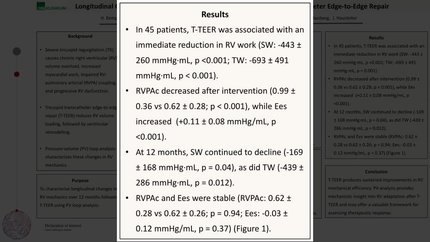
Effective TR reduction appears to be a key determinant of acute biventricular adaptation following transcatheter tricuspid valve interventions. Optimal reduction (<moderate TR) is associated with RV volume unloading, increased afterload, and a coupled rise in contractile indices, resulting in improved LV filling. In contrast, suboptimal TR reduction yields limited biventricular benefit.
Contributors

Giulio M Mondellini
Author
Antoon J M van den Enden
Author
Mark M P van den Dorpel
Author
Christiaan L Meuwese
Author

Julio Echarte
Author
Edoardo Zancanaro
Author
Matteo Sturla
Author
A Shaheer Ahmed
Author
Deepti Ranganathan
Author
You may be interested in