Coronary stent infection causing perforation and thrombotic occlusion after early post-PCI methicillin-resistant Staphylococcus aureus bacteraemia: an autopsy case report

European Heart Journal - Case Reports

8 September 2026
Organised by: Logo
ESC Journals CORONARY ARTERY DISEASE, ACUTE CORONARY SYNDROMES, ACUTE CARDIAC CARE Interventional Cardiology

Abstract

AbstractBackground

Coronary stent infection (CSI) is rare but can be fatal. In Staphylococcus aureus bacteraemia (SAB), treatment duration is guided by classification as uncomplicated or complicated SAB. However, whether a recently implanted drug-eluting stent (DES) should be regarded as intravascular prosthetic material remains unclear.

Case Summary

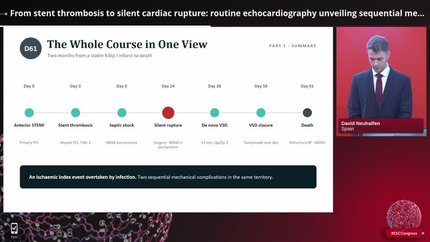
An 83-year-old woman underwent percutaneous coronary intervention (PCI) for a severely calcified right coronary ostial lesion. After rotational atherectomy, a DES was implanted, and final angiography showed adequate expansion. On hospital day 7, cellulitis developed at a peripheral intravenous catheter site. Blood and skin cultures grew methicillin-resistant Staphylococcus aureus (MRSA). Intravenous linezolid was started because of renal dysfunction. The episode was considered to be uncomplicated SAB because follow-up blood cultures were negative, fever resolved, transthoracic echocardiography showed no vegetation, and no metastatic infection was identified. Antimicrobial therapy was stopped after 14 days. Fever and inflammatory markers did not recur, but nonspecific chest symptoms persisted. Follow-up coronary angiography showed no clear abnormalities. After discharge, MRSA bacteraemia recurred. The patient developed shock with inferior ST-segment elevation, followed by pulseless electrical activity and death. Autopsy revealed coronary wall disruption, surrounding haemorrhage, ostial thrombotic occlusion, gram-positive cocci, and neutrophilic infiltration near the right coronary ostial stent, leading to the diagnosis of CSI.

Discussion

This case raises the possibility that a recently implanted DES may serve as an occult endovascular focus during SAB. Negative follow-up blood cultures, defervescence, normalized inflammatory markers, and unrevealing imaging may not exclude CSI; persistent or recurrent chest symptoms after recent PCI should prompt targeted reassessment.

Contributors

Shota Hirai
Shota Hirai

Author

Nippon Life Hospital Osaka , Japan

Goro Fujiki
Goro Fujiki

Author

The University of Tokyo Hospital Tokyo , Japan