Cryoballoon left atrial posterior wall isolation using the cross-over technique in situs inversus with dextrocardia: a case report
European Heart Journal - Case Reports


Abstract
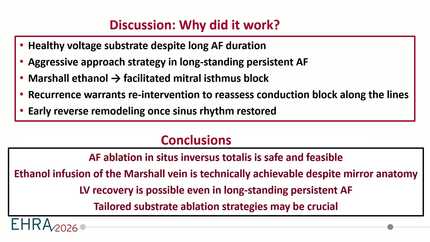
Situs inversus with dextrocardia (SID) is a rare congenital condition with fully mirrored cardiac anatomy, posing unique technical challenges for catheter ablation of atrial fibrillation (AF). Although cryoballoon (CB)-based left atrial posterior wall isolation (LAPWI) has recently been reported in a patient with SID, adjunctive radiofrequency catheter ablation was required to complete posterior wall isolation. We present a case in which complete LAPWI was achieved exclusively using CB applications, employing the previously described cross-over technique.
A 69-year-old woman with SID and drug-refractory persistent AF underwent catheter ablation using a fourth-generation CB system. To accommodate mirrored anatomy, the procedure was performed using mirror-image fluoroscopy and intentionally reversed catheter manipulation to restore conventional spatial orientation. Pulmonary vein isolation was achieved, followed by LAPWI using the cross-over technique, in which overlapping CB applications were delivered from both left- and right-sided pulmonary vein anchor positions to improve lesion continuity across the left atrial posterior wall. Complete LAPWI was confirmed by voltage mapping and pacing manoeuvres demonstrating both entrance and exit block. No periprocedural complications occurred. The patient remained free from AF recurrence for 48 months without antiarrhythmic therapy.
This case demonstrates that complete CB-based LAPWI using the cross-over technique is feasible even in anatomically mirrored hearts. The successful use of mirror-image fluoroscopy and intentionally reversed catheter manipulation provides practical technical insights and highlights the importance of deliberate spatial adaptation when performing complex left atrial ablation in patients with SID.
Contributors

Fuminori Odagiri
Author
Takashi Tokano
Author
Tetsuro Miyazaki
Author
Kai Ishii
Author

Flemming Javier Olsen
Author
Sebastian Feickert
Author
Andreas Metzner
Author
Deepti Ranganathan
Author
You may be interested in