Associations between specific non-sustained ventricular tachycardia characteristics and sudden cardiac death in hypertrophic cardiomyopathy
EP Europace Journal


Abstract
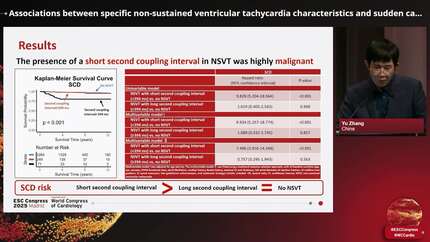
Non-sustained ventricular tachycardia (NSVT) is a well-established risk factor for sudden cardiac death (SCD) in hypertrophic cardiomyopathy (HCM). However, its characteristics have been overlooked. This study evaluates the prognostic value of NSVT characteristics, particularly coupling intervals, for HCM risk stratification.
This retrospective, multicentre study included 2625 HCM patients. Twenty-four-hour Holter recordings were assessed for NSVT and its characteristics (frequency, duration, and coupling intervals). The primary endpoint was SCD; the secondary endpoints were cardiovascular and all-cause death. Two thousand five hundred and eighty-four patients were analysed (49.6 ± 15.2 years; 62.4% male). Non-sustained ventricular tachycardia occurred in 320 (12.4%). During the median follow-up of 4.4 years, there were 221 all-cause deaths (8.6%), 159 cardiovascular deaths (6.2%), and 64 SCDs (2.5%). Among characteristics, the second coupling interval best predicted adverse outcomes (optimal cut-off = 394 ms). Non-sustained ventricular tachycardia frequency and duration were not prognostic. In univariable and multivariable analyses, a second coupling interval < 394 ms markedly increased the risk of SCD [hazard ratio (HR) 8.36, 95% confidence interval (CI) 4.33–16.12,
A short second coupling interval of NSVT poses a higher SCD risk in HCM than a long one. Detailed dissection of NSVT characteristics may improve decision-making for implantable cardioverter-defibrillator implantation in HCM.
Contributors

Yu Zhang
Author
Fang Qin
Author
Yunfan Guan
Author

Lutong Pu
Author
Yu Xia
Author
Channa Zhang
Author
Dong Wang
Author
Xueyi Wu
Author
Mo Zhang
Author
Limei Wang
Author
Wen Jiang
Author
Lianming Kang
Author
Lianjun Xu
Author
Yucheng Chen
Author
Lei Song
Author
You may be interested in