Beta-blockers in patients with uncomplicated arterial hypertension: data from the Campania Salute Network Registry
European Heart Journal - Quality of Care and Clinical Outcomes


Abstract
The role of beta-blockers in the management of uncomplicated arterial hypertension remains a subject of clinical debate. While beta-blockers are established cornerstones for heart failure and post-myocardial infarction care, their independent efficacy in reducing major adverse cardiovascular events (MACE) in patients without these compelling indications is less clear. This study aimed to evaluate the association between beta-blocker use and MACE in a real-world hypertensive population without prevalent cardiovascular diseases.
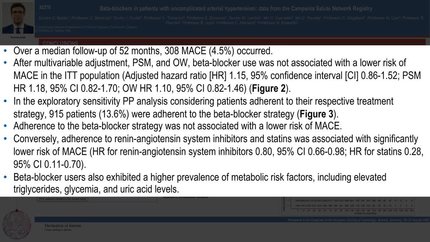
We analysed 6702 hypertensive patients from the Campania Salute Network (CSN) registry without prevalent coronary or cerebrovascular disease, valvular heart disease, or heart failure. The association between beta-blocker use and MACE was assessed using three statistical approaches: multivariable-adjusted Cox proportional hazards regression, propensity score matching (PSM), and overlap weighting (OW). An intention-to-treat (ITT) analysis was performed based on baseline prescription, and an exploratory per-protocol (PP) sensitivity analysis was conducted to evaluate the role of sustained treatment adherence. At baseline, 18.1% (
In patients with uncomplicated hypertension, beta-blocker use was not associated with a lower risk of MACE, regardless of treatment adherence. These findings are consistent with clinical guidelines that prioritize non-beta-blocker regimens and recommend using beta-blockers in the presence of compelling indications.
Contributors


Costantino Mancusi
Author
Ilaria Fucile
Author
Valentina Trimarco
Author
Eduardo Bossone
Author
Maria Lembo
Author
Grazia Canciello
Author
Daniela Pacella
Author
Giuseppe Giugliano
Author
Maria Angela Losi
Author

Raffaele Izzo
Author
Giovanni Esposito
Author
You may be interested in