Potential bias in efficacy estimates due to intercurrent treatment discontinuations

European Heart Journal - Quality of Care and Clinical Outcomes

31 May 2026
Organised by: Logo
ESC Journals CARDIOVASCULAR PHARMACOLOGY DISEASES OF THE AORTA, PERIPHERAL VASCULAR DISEASE, STROKE Stroke Research Methodology

Abstract

AbstractAims

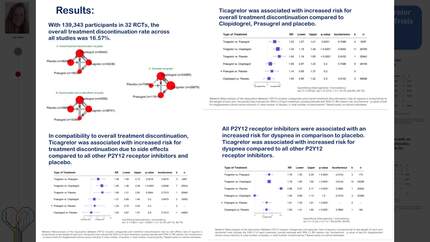
Treatment discontinuation is a common intercurrent event in randomized clinical trials (RCTs) that can bias treatment effect estimates, yet it remains under recognized and inconsistently addressed. Antithrombotic trials provide a relevant case, as bleeding-related discontinuation is common and more often occur in patients at increased risk also for ischaemic events.

Methods and results

We reviewed large antithrombotic RCTs published in The New England Journal of Medicine (2020–2025) to assess reporting and analytic handling of treatment discontinuation. We also conducted simulations to examine how discontinuation patterns influence efficacy estimates under three scenarios: discontinuation only in the treatment arm, in both arms with similar patterns, and in both arms but outcome-associated only in the treatment arm. Treatment policy (intention-to-treat) and while-on-treatment strategies were compared within the ICH E9(R1) framework. Among fourteen reviewed antithrombotic RCTs, about one-third of patients discontinued treatment in trials with more than 6 months follow-up, with higher imbalance in open-label studies. Over half of discontinuations were safety-related, yet timing and temporary interruptions were rarely reported. Most reported both ITT and per-protocol (PP) analyses, with PP assuming non-informative censoring and yielding larger efficacy estimates. In simulations, treatment policy and while-on-treatment strategies were biased when discontinuation was outcome-associated, while Simon–Makuch curves helped identify prognostic discontinuation differing by treatment arm.

Conclusion

Discontinuation is common, prognostically meaningful, and often oversimplified in analysis, threatening the validity of RCT findings. Explicitly addressing discontinuation as an intercurrent event within the estimand framework, along with stratified outcome curves, can improve interpretation and support more robust trial conclusions.

Contributors

Mario Gaudino
Mario Gaudino

Author

NewYork-Presbyterian Hospital/Weill Cornell Medical Centre New York , United States of America