Rescue transseptal percutaneous mitral balloon valvuloplasty for early bioprosthetic mitral valve thrombosis during VA-ECMO support: a case report
European Heart Journal - Case Reports


Abstract
Early bioprosthetic mitral valve thrombosis (BPVT) is a rare but life-threatening cause of acute prosthetic obstruction after mitral valve surgery. Management is particularly challenging in postcardiotomy shock requiring veno-arterial extracorporeal membrane oxygenation (VA-ECMO), where low native cardiac output and left-sided stasis may promote thrombosis despite systemic anticoagulation.
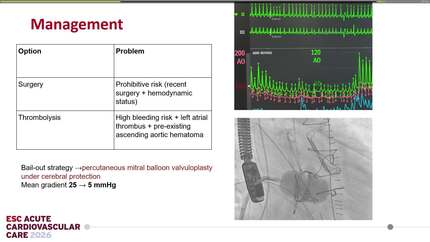
A 74-year-old man underwent bioprosthetic mitral valve replacement, tricuspid annuloplasty, pulmonary vein isolation, and left atrial appendage closure for severe primary mitral regurgitation, with intra-operative identification of ascending aortic dissection requiring replacement of the ascending aorta and hemiarch. Because of severe postcardiotomy shock with biventricular dysfunction, peripheral VA-ECMO was initiated. On post-operative Day 2, transoesophageal echocardiography demonstrated severe bioprosthetic mitral obstruction with restricted leaflet motion and a mean transmitral gradient of 25 mmHg. Repeat imaging showed persistent obstruction with extensive left atrial thrombus despite anticoagulation optimization. Surgical reintervention and systemic fibrinolysis were considered prohibitive. After Heart Team discussion, rescue transseptal percutaneous mitral balloon valvuloplasty was performed under cerebral embolic protection using a 26-mm Inoue balloon. Immediate post-procedural imaging showed improved leaflet mobility and reduction of the mean transmitral gradient from 25 to 4 mmHg, without significant mitral regurgitation. The patient was successfully weaned from VA-ECMO and remained clinically stable at 2-month follow-up.
This case illustrates that, in carefully selected critically ill patients with catastrophic early BPVT during VA-ECMO support, rescue transseptal balloon dilatation may be considered as an exceptional salvage strategy when surgery and fibrinolysis are not viable. In highly selected patients with early BPVT causing severe haemodynamic compromise during VA-ECMO support, transseptal balloon dilatation may serve as a bridge-to-recovery option when surgery and fibrinolysis are contraindicated or carry prohibitive risk.
Contributors

Teresa de la Torre Úbeda
Author
Andrea Virginia Monastyrski
Author
Edoardo Zancanaro
Author
Youssef Mahmoud AbdElMoneim
Author
Natsuhiko Ehara
Author
Deepti Ranganathan
Author
You may be interested in