Abatacept for steroid-refractory fulminant immune checkpoint inhibitor myocarditis with triple M overlap syndrome: a case report with serial endomyocardial biopsy assessment
European Heart Journal - Case Reports


Abstract
Triple M overlap syndrome is a rare, but often fatal, immune-related adverse event. Evidence on the effectiveness of immunosuppressive treatments, including abatacept, and disease monitoring in complex cases remains limited.
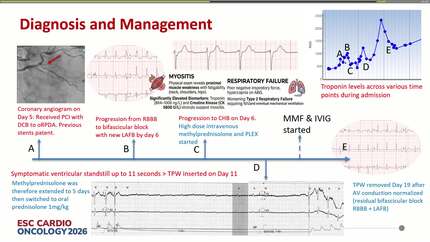
A man in his 60s developed fulminant immune checkpoint inhibitor (ICI)-related myocarditis after nivolumab plus ipilimumab for recurrent lung adenocarcinoma, complicated by triple M overlap syndrome (myocarditis, myositis, and myasthenia gravis). Despite high-dose corticosteroids and intravenous immunoglobulin, cardiac biomarkers worsened, with progressive conduction abnormalities and a rapid decline in the left ventricular ejection fraction to 23%. Upon transfer to our institution, he developed sustained ventricular tachycardia, requiring direct current cardioversion and intra-aortic balloon pump support. Endomyocardial biopsy (EMB) at admission showed CD8+ T-cell-predominant myocarditis, consistent with a fulminant, steroid-refractory disease course. Abatacept was initiated after a multidisciplinary discussion, resulting in haemodynamic and arrhythmic stabilization. Guided by serial EMB findings of residual myocardial inflammation, abatacept was administered four times by hospital Day 30, along with intravenous methylprednisolone pulse therapy, plasma exchange, intravenous immunoglobulin, and tacrolimus. Left ventricular ejection fraction gradually improved to 56%, and a follow-up EMB on Day 88 demonstrated marked histopathological recovery.
This case illustrates that abatacept-based multidisciplinary therapy may help stabilize fulminant steroid-refractory ICI-related myocarditis with triple M overlap syndrome. Serial EMB provided a histopathological assessment of residual myocardial inflammation and guided immunosuppressive therapy, suggesting a potential role for serial biopsy in complex cases.
Contributors

Ruriko Matsui
Author
Kimi Sato
Author
Kazuko Tajiri
Author
Tomoko Ishizu
Author
Giacomo Tini Melato
Author
Linda Piras
Author
Deepti Ranganathan
Author
You may be interested in