When rare meets rarer: constrictive pericarditis in Erdheim–Chester disease—a case report
European Heart Journal - Case Reports


Abstract
Erdheim–Chester disease (ECD) is a rare clonal non-Langerhans cell histiocytosis driven predominantly by MAPK pathway alterations. Although cardiovascular involvement is frequent, it is usually subclinical, while constrictive pericarditis is exceptionally rare.
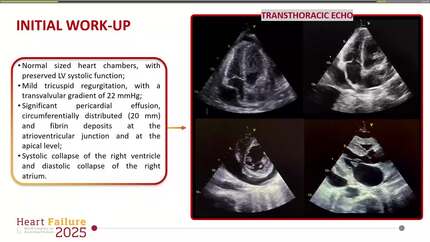
A 57-year-old man with multisystem ECD presented with signs of congestive heart failure. Multimodality imaging demonstrated extensive cardiovascular involvement, with marked pericardial thickening and haemodynamic features of constrictive pericarditis on echocardiography, diffuse late gadolinium pericardial enhancement on cardiac magnetic resonance, and circumferential periarterial infiltration on computed tomography angiography. Despite intensive medical therapy resulting in temporary haemodynamic improvement, persistent constrictive physiology prompted urgent pericardiectomy. Intraoperatively, the pericardium was diffusely thickened and densely adherent to the epicardium. The post-operative course was complicated by refractory cardiogenic shock and multiorgan failure, leading to the patient’s death. Autopsy revealed extensive histiocytic infiltration of the pericardium and myocardium, demonstrating that extensive cardiovascular involvement in ECD, rather than isolated pericardial fibrosis, was causative for the constrictive physiology.
This case illustrates the potentially devastating consequences of cardiovascular involvement in ECD. It suggests that once extensive myocardial infiltration by histiocytes additional to pericardial fibrosis has evolved, pericardiectomy alone may be insufficient to relieve the constrictive physiology and alter clinical course.
Contributors

Maria Dimova-Mileva
Author
Iliyan Kanchev
Author
Elena Marinova
Author
Georgi Bachvarov
Author
Anita Dimitrova
Author
Domenico D'Amario
Author
Deepti Ranganathan
Author
You may be interested in