Prediction of clinical outcomes based on phenotypic grouping using left ventricular and left atrial strains in patients with HFpEF

European Heart Journal - Cardiovascular Imaging

7 July 2026
Organised by: Logo
ESC Journals HEART FAILURE Acute Heart Failure IMAGING Echocardiography

Abstract

AbstractAims

Heart failure with preserved ejection fraction (HFpEF) is a heterogeneous syndrome with poor clinical outcomes similar to HF with reduced ejection fraction. We investigated whether phenotyping based on dual-chamber strain analysis (left ventricular global longitudinal strain [LVGLS] and left atrial reservoir strain [LARS]) provides incremental prognostic value in patients with HFpEF.

Methods and results

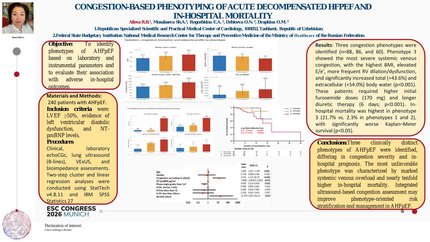
We analysed dual-chamber strains from all HFpEF patients in the multicentre STRATS-AHF registry. We categorized all patients into four groups according to cut-off values (LVGLS ≤−16%; LARS ≥18%). The primary outcome was 5-year all-cause mortality. We analysed a total of 1184 HFpEF patients (mean age: 73.4 years, 60.4% female) and categorized them into four groups: Group 1 (preserved dual-chamber strains, n = 340), Group 2 (impaired LVGLS/preserved LARS, n = 239), Group 3 (preserved LVGLS/impaired LARS, n = 186), and Group 4 (impaired dual-chamber strains, n = 419). Compared with Group 1, Group 4 exhibited the highest prevalence of atrial fibrillation (AF, 62.8%), the highest E/e′ ratio, and the most impaired right ventricular global longitudinal strain. In univariate analysis, mortality risk increased progressively from Group 2 to Group 4 (Group 2: HR = 1.341, P = 0.016; Group 3: 1.578, P < 0.001; Group 4: HR = 1.822, P < 0.001). In multivariate models, Group 2 (adjusted HR = 1.664, P = 0.011) and Group 4 (adjusted HR = 1.660, P = 0.026) remained independent predictors of death compared to Group 1. Group 3 demonstrated insignificant risk after adjusting for other variables, including age and AF (adjusted HR = 1.509, P = 0.171).

Conclusion

Combined LV and LA strain assessment identified distinct HFpEF phenotypes and provided valuable prognostic information in HFpEF patients.

Contributors

Jae-Hyeong Park
Jae-Hyeong Park

Author

Chungnam National University Hospital Daejeon , Korea (Republic of)

Jin Joo Park
Jin Joo Park

Author

Seoul National University Bundang Hospital Seongnam , Korea (Republic of)