Air quality and health implications of exposure to ultrafine particle pollution
Cardiovascular Research


Abstract
Ultrafine particles (UFPs) smaller than 100 nm are ubiquitous in polluted air. Although they carry little mass, UFPs have a large exposure surface area, can bypass respiratory defences, translocate into the brain and bloodstream, and impact the heart and other organs. Here, we assess the role of UFPs in air quality and the health burden they impose.
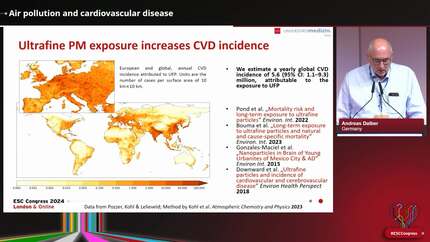
We integrated Earth observations with machine learning to estimate long-term UFP exposure at 1 km resolution, demonstrating that they pose a major air quality concern in urban environments, with annual mean concentrations typically ranging between 10 000 and 30 000 particles/cm−3. Model calculations suggest that black and organic carbon are primary components of pollution UFPs. Based on a meta-analysis of epidemiological cohort studies in Europe and North America, we derived a pooled hazard ratio for mortality and combined it with our UFP data. We estimate a mortality density of 35.7 (15.8–65.5) per 100 000 people annually in Europe, and 27.4 (12.9–47.4) per 100 000 in North America, the latter being close to the global mean. We find that UFP exposure and mortality densities are particularly high in South and Eastern Europe. Since observational data for other regions are limited, global calculations primarily depend on modelling. We indicatively estimate that 1.99 (0.81–3.89) million excess deaths per year are attributable to UFP exposure. This could account for approximately 5% of total mortality from non-communicable diseases, to a large degree (about half) due to cardiovascular conditions. Globally, about 91% of UFP-related excess mortality occurs in urban and suburban environments, and much of that (78%) in densely populated urban areas.
Health-improving interventions should target combustion sources in cities, particularly those related to energy consumption, industry, and traffic. An annual air quality limit of 5000 cm−3 could reduce global excess mortality by about 45%.
Contributors

Pantelis Georgiades
Author
Matthias Kohl
Author
Yafang Cheng
Author
Theodoros Christoudias
Author
Jean Sciare
Author
Mihalis Nicolaou
Author
Constantine Dovrolis
Author
Mohammed Fnais
Author
Markku Kulmala
Author

Omar Hahad
Author
Marin Kuntic
Author
Thomas Münzel
Author
Andrea Pozzer
Author
You may be interested in