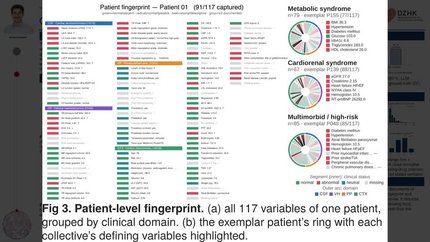
Development of an LLM pipeline exceeding physician-documented cardiovascular risk scores under routine clinical conditions
European Heart Journal - Digital Health


Abstract
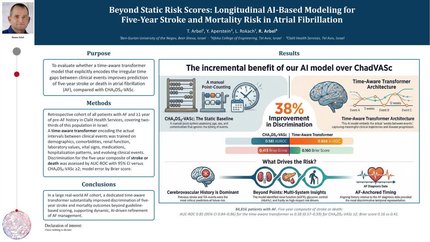
Risk scores are essential to evidence-based cardiovascular care, but manual calculation is labour intensive and error prone. Large language models (LLMs) could automate this process, yet LLMs are limited by their propensity for calculation errors and factual hallucinations. Pipelines separating LLM-based data extraction from deterministic score computation may improve reliability and transparency.
We conducted a retrospective diagnostic study at a quaternary heart centre in Germany (January 2020 to July 2023). Patients with atrial fibrillation (
Pipelines combining expert-curated knowledge injection, LLM-based clinical data extraction, and deterministic score calculation enable accurate and scalable cardiovascular risk score computation from unstructured real-world clinical data, outperforming physician-documented scores. Such pipelines could form the basis for clinical decision-support systems that automate routine risk assessment, reduce clinician workload, and promote more consistent evidence-based care.
Contributors

Tobias Roeschl
Author
Marie Hoffmann
Author
Axel Unbehaun
Author
Henryk Dreger
Author
Gerhard Hindricks
Author
Volkmar Falk
Author
Ran Balicer
Author
Radu Tanacli
Author
Felix Hohendanner
Author
Alexander Meyer
Author
You may be interested in