Impact of baseline renal dysfunction on cardiac outcomes and end-stage renal disease in heart failure patients with mitral regurgitation: the COAPT trial
European Heart Journal


Abstract
Baseline renal dysfunction (RD) adversely impacts outcomes among patients with heart failure (HF) and severe secondary mitral regurgitation (MR). Heart failure and MR, in turn, accelerate progression to end-stage renal disease (ESRD), worsening prognosis. We sought to determine the impact of RD in HF patients with severe MR and the impact of transcatheter mitral valve repair (TMVr) on new-onset ESRD and the need for renal replacement therapy (RRT).
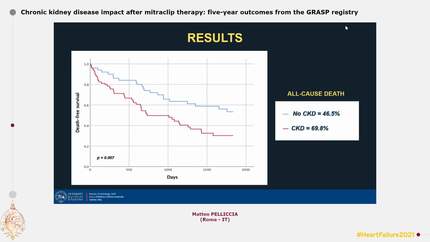
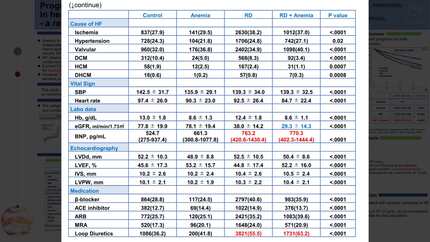
The COAPT trial randomized 614 patients with HF and severe MR to MitraClip plus guideline-directed medical therapy (GDMT) vs. GDMT alone. Patients were stratified into three RD subgroups based on baseline estimated glomerular filtration rate (eGFR, mL/min/1.73 m2): none (≥60), moderate (30–60), and severe (<30). End-stage renal disease was defined as eGFR <15 mL/min/1.73 m2 or RRT. The 2-year rates of all-cause death or HF hospitalization (HFH), new-onset ESRD, and RRT according to RD and treatment were assessed. Baseline RD was present in 77.0% of patients, including 23.8% severe RD, 6.0% ESRD, and 5.2% RRT. Worse RD was associated with greater 2-year risk of death or HFH (none 45.3%; moderate 53.9%; severe 69.2%;
Baseline RD was common in the HF patients with severe MR enrolled in COAPT and strongly predicted 2-year death and HFH. MitraClip treatment reduced new-onset ESRD and the need for RRT, contributing to the improved prognosis after TMVr.
Contributors

Nirat Beohar
Author
Gorav Ailawadi
Author
Lak N Kotinkaduwa
Author
Björn Redfors
Author
Matheus Simonato
Author
Zixuan Zhang
Author
Loren Garrison Morgan
Author
Esteban Escolar
Author
Saibal Kar
Author
David Scott Lim
Author
Jacob M Mishell
Author
Brian K Whisenant
Author
William T Abraham
Author
JoAnn Lindenfeld
Author
Michael J Mack
Author
Gregg W Stone
Author
You may be interested in