Missed opportunity for fibrinolysis in ST-segment–elevation myocardial infarction: the nationwide France-PCI registry
European Heart Journal - Quality of Care and Clinical Outcomes


Abstract
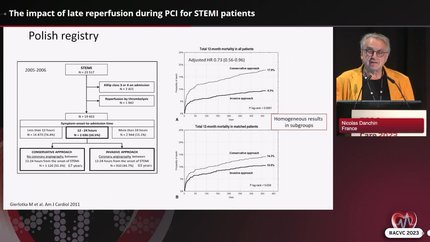
Timely reperfusion is a key quality-of-care target in ST-segment elevation myocardial infarction (STEMI). When primary percutaneous coronary intervention (PPCI) cannot be delivered within 120 min from first medical contact (FMC), guidelines recommend fibrinolysis as early as possible within 12 h of symptom onset in eligible patients. We quantified missed opportunities for fibrinolysis in a nationwide STEMI network.
We analysed consecutive STEMI patients enrolled ≤24 h from symptom onset in the France-PCI registry (2014–22). First medical contact was approximated by the first diagnostic electrocardiogram (ECG). Initial reperfusion was classified as timely PPCI (FMC-to-device ≤120 min), delayed PPCI (>120 min), or fibrinolysis. Among delayed PPCI, eligibility for fibrinolysis required no oral anticoagulant, no prior stroke, and no documented contraindication. We evaluated temporal trends, regional variation, and outcomes. Among 19 472 patients, 12 633 (64.9%) underwent timely PPCI, 5895 (30.3%) delayed PPCI, and 944 (4.8%) fibrinolysis. Timely PPCI increased over time, whereas fibrinolysis declined. Among delayed PPCI, 3279/5895 (55.6%) presented within the prespecified early-presenter window (symptom-to-ECG ≤3 h) and met our strict fibrinolysis-eligibility criteria, yet underwent delayed PPCI; this proportion remained stable across years, with marked regional heterogeneity. Fibrinolysis use was favoured by mobile intensive care units, helicopter transport, and longer distance to PPCI centres, whereas older age was associated with delayed PPCI without fibrinolysis.
In this national STEMI network, more than half of delayed PPCI in eligible early presenters represented a persistent missed-fibrinolysis gap. Routine audit of delayed PCI and missed fibrinolysis as system-level quality metrics should guide time-based pre-hospital triage and align reperfusion with guideline-recommended targets.
Contributors


Matthieu Daniel
Author

Youssef Rahal
Author
Marine Quillot
Author
Olivier Nugue
Author
Olivier Tricot
Author
Ouissem Zid
Author
Benoit Herce
Author
Thibault Perret
Author
Laurent Leborgne
Author
Fabrice Prunier
Author
Nicolas Meneveau
Author
Luc Maillard
Author
Franck Barbou
Author
Christophe Robin
Author
Nizar Ben Mansour
Author
Akram Chmait
Author
François Huchet
Author
Yoann Lefrancois
Author
Guillaume Molins
Author
Erwan Bressollette
Author
Guillaume Cayla
Author
Julien Adjedj
Author
Eric Van Belle
Author
Christophe Saint Etienne
Author
René Koning
Author
Hakim Benamer
Author
Philippe Commeau
Author
Stephan Chassaing
Author
Pascal Motreff
Author
Michel Zeitouni
Author
Grégoire Rangé
Author
You may be interested in