Valvular heart disease in Cancer patiEntS - prevAlence, Relevance, and therapeutic management - The CESAR study
European Heart Journal Supplements


Abstract
The burden of cardio-oncologic disease is estimated to increase considerably due to remarkable advancements in cancer therapy over recent years. In this context, valvular heart disease (VHD), which is widespread in an aging population, may become a critical concern for future healthcare management. Despite its clinical relevance, the epidemiology, prognostic impact, and current management approaches of VHD in cancer patients remain poorly understood.
The CESAR study aimed to evaluate the prevalence, characteristics, management approaches and associated outcomes of VHD in cancer patients. With this study, we strive to lay the foundation for prospective clinical trials aimed at optimizing management pathways of cancer patients with concurrent VHD.
This large-scale observational cohort study included adult patients (≥18 years) with confirmed oncologic diagnosis and a transthoracic echocardiographic at the time of cancer diagnosis (+/- 12 months) recruited at a tertiary referral center. Mortality (all-cause and cardiovascular), performance of valvular interventions, and their impact on survival served as endpoints. Multivariable Cox regression and adjusted Kaplan Meier estimates were used for outcome analyses. Time of echocardiography served as baseline date for all analyses. Performance of valve interventions was analyzed as a time-dependent variable.
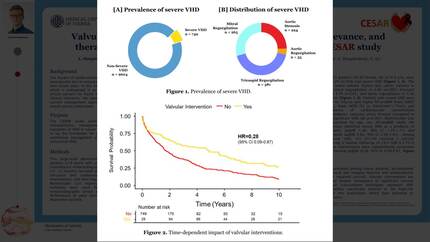
Among 16,314 cancer patients, 997 (6.1%) had significant valvular heart disease. The most common significant lesions were tricuspid regurgitation (43.2%) and mitral regurgitation (32.3%), followed by aortic stenosis (12.8%) and aortic regurgitation (10.3%, Figure 1). Compared with patients without significant VHD, those with significant VHD were older (median 71 vs. 66 years), had higher NT-proBNP (median 1217 vs. 562), lower left ventricular ejection fraction (median 53% vs. 61%), and a markedly higher burden of cardiovascular comorbidities (all p<0.001). In multivariable Cox regression, significant VHD was independently associated with higher all-cause mortality (adjHR 1.9, 95% CI 1.5–2.4) and cardiovascular mortality (adjHR 3.0, 95% CI 2.2–4.0). During a median follow-up of 23 months, 245 (25%) underwent a valvular intervention, which was independently associated with improved survival (adjHR 0.28, 95% CI 0.09–0.87, Figure 2).
In cancer patients, significant VHD is present in ~6% and is associated with substantially increased all-cause and cardiovascular mortality. Valvular interventions are rarely performed despite conveyance of significant survival benefit. Low-risk transcatheter techniques represent VHD treatment modalities specifically tailored to the high-risk constellation of this population, which bare potential to ameliorate outcomes. Prevalence of Significant VHD Impact of Valvular Interventions
Contributors




You may be interested in