Impact of hormonal therapy on NT-proBNP levels in breast cancer patients
European Heart Journal Supplements


Abstract
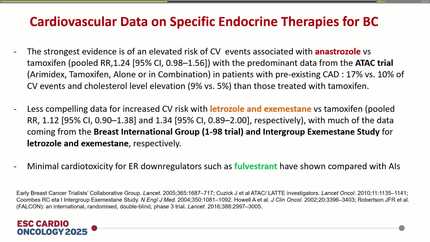
Hormonal Therapy is a cornerstone in the management of hormone receptor-positive (HR+) breast cancer (BC)(1). While generally considered to have a favourable safety profile compared to chemotherapy or targeted therapies like trastuzumab, emerging evidence suggest that Aromatase Inhibitors (AI) maybe associated with an increased risk of Cardiovascular (CV) disease (2). Cardiac imaging parameters - left ventricular ejection fraction (LVEF) and left ventricular global longitudinal strain (LVGLS) – together with circulating biomarkers, including N-terminal pro-B-type natriuretic peptide (NT-proBNP) and troponin, are routinely used for the detection of subclinical cancer therapy related cardiac dysfunction (CTRCD) (3). However, the potential cardiotoxic effects of hormonal therapy in patients with BC remain insufficiently investigated.
The aim of this study was to assess the cardiotoxic effects of aromatase inhibitor therapy in patients with breast cancer.
We analyzed data of patients from the ongoing CARDIOCARE Prospective Clinical Study with histologically confirmed BC treated exclusively with adjuvant hormonal therapy (n=147). Baseline cardiovascular risk factors were descriptively analyzed (Table 1). Patients were classified into group A (those who developed CTRCD according to HFA-ICOS universal definition) and group B (those without CTRCD). For the present analysis, patients lacking paired NT-proBNP data were excluded, resulting in a final cohort of 25 patients with CTRCD and 38 patients without CTRCD. Statistical significance for NT-proBNP was assessed using a one-sample Wilcoxon signed-rank test (μ=0.5) on the normalized data.
In the CTRCD group, median NT-proBNP increased significantly from 117.5 pg/mL at baseline to 212 pg/mL after 3 months of therapy (p < 0.001), and to 150.3 pg/mL after 12 months of therapy (p < 0.001). While LVEF, LVGLS and troponin levels did not change significantly. Conversely, in the non-CTRCD group, median NT-proBNP levels remained stable (Baseline: 104.8 pg/mL vs. 3 months: 106.8 pg/mL (p = 0.055) vs 6 months (101.4 pg/mL) vs 9 months (81.6 pg/mL) vs 12 months (98.7 pg/mL). Troponin and imaging biomarkers (LVEF, LVGLS) also remained stable across all four assessed time points (at 3, 6, 9 and 12 months from the initiation of AI) in this group (Table 2).
In this cohort of breast cancer patients treated exclusively with AI, a statistically significant increase in NT-proBNP levels was observed as early as 3 months and again at 12 months among those who developed CTRCD, despite preserved systolic function and deformation mechanics and troponin levels. Although limited by sample size, these findings suggest that AI therapy may be associated with early subclinical myocardial stress detectable by NT-proBNP elevation in patients who develop CTRCD, highlighting the potential value of biomarker-based surveillance in this population. Descriptive statistics Longitudinal changes
Contributors

C Andreou
Author

P Vogazianos
Author
D Vraxnos
Author
M Kedariti
Author

A Papakonstantinou
Author
C Cipolla
Author
K Mazzocco
Author
D Fotiadis
Author
You may be interested in