Safety of pulsed-field ablation combined with IVUS-guided pulmonary vein stenting during atrial fibrillation ablation: a case report
European Heart Journal - Case Reports


Abstract
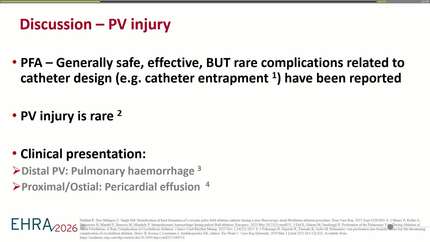
Pulmonary vein stenosis (PVS) is an uncommon but serious complication of atrial fibrillation (AF) ablation. Angioplasty with stent implantation is the standard treatment for severe PVS; however, restenosis and re-occlusion remain frequent challenges. Pulsed-field ablation (PFA), a novel non-thermal ablation modality for pulmonary vein isolation, causes minimal structural damage and may therefore be particularly suitable and safer for complex redo procedures involving previously stenosed pulmonary veins.
A 50-year-old man underwent pulmonary vein isolation using radiofrequency in February 2023. A few months later, he developed breathlessness, and a computed tomography scan showed a stenosis of the left inferior pulmonary vein (LIPV) and normal coronary arteries. He also had recurrent arrhythmias. In March 2024, with a cerebral protection device
He was reviewed in December 2024 and was free from breathlessness but had recurrent palpitations. By spring 2025, he had also become breathless, and imaging showed subtotal occlusion of the LIPV stent with reduced perfusion of the left lower lobe despite continuation of edoxaban and clopidogrel after initial stenting. In May 2025, he was admitted for intravascular ultrasound (IVUS)-guided balloon angioplasty with a 7-mm drug-eluting balloon following pre-dilatation, which successfully restored stent patency. PFA was then performed on all pulmonary veins, including around the previously stented LIPV, avoiding direct catheter contact with the stent. The procedure and recovery were uneventful, and the patient’s symptoms improved markedly. He remained free from arrhythmias in April 2026 (∼1 year follow-up).
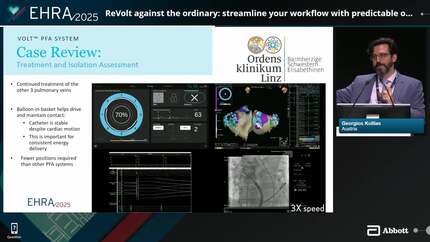
This case highlights the complexity of managing AF ablation-related PVS and underscores the role of IVUS in guiding revascularization. It also demonstrates the safety of PFA (in particular Varipulse™, J&J MedTech) near a stented pulmonary vein, achieving effective electrical isolation with minimal additional structural injury.
Contributors

Tomasz Jadczyk
Author
Lorenzo Caratti di Lanzacco
Author
Julian Jarman
Author
Jonathan Hill
Author
Vias Markides
Author
Andreas Metzner
Author
Nikesh Jathanna
Author
Tobias Reichlin
Author
Sorin Popescu
Author
Deepti Ranganathan
Author
You may be interested in