Emergency Bentall procedure at 15 weeks’ gestation for giant aortic root aneurysm in Marfan syndrome: a case report
European Heart Journal - Case Reports


Abstract
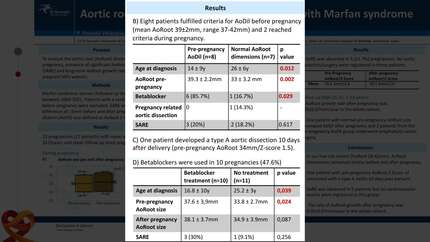
Pregnancy in women with Marfan syndrome markedly increases the risk of life-threatening aortic complications due to superimposed haemodynamic and hormonal stress on an intrinsically fragile aortic wall. Management becomes particularly challenging when a giant aortic root or ascending aortic aneurysm with severe aortic regurgitation is diagnosed during early pregnancy before fetal viability.
A 19-year-old primigravid woman at 15 weeks and 2 days of gestation with known Marfan syndrome presented with persistent palpitations. Evaluation revealed a giant fusiform aneurysm involving the aortic root and ascending aorta measuring 69 mm on transthoracic echocardiography and ∼9–10 cm intraoperatively, severe aortic regurgitation due to annular dilation, and left ventricular systolic dysfunction with an ejection fraction of 40%–42%. Following multidisciplinary consultation and counselling regarding maternal and fetal risks, urgent surgical intervention was undertaken without termination of pregnancy. The patient underwent an emergency Bentall procedure. The perioperative course was complicated by major bleeding requiring delayed sternal closure and transfusion support. Post-operative echocardiography demonstrated a functioning mechanical prosthesis with acceptable haemodynamics and persistent severe left ventricular systolic dysfunction with an ejection fraction of 25%–30%. Obstetric ultrasonography confirmed a viable fetus. The patient was discharged in stable condition on post-operative day 11.
This case demonstrates that emergency aortic root replacement during early second-trimester pregnancy may be lifesaving in selected patients with Marfan syndrome and severe aortic pathology when guided by multidisciplinary coordination and meticulous perioperative management.
Contributors

Mehran Mottahedi
Author
Setareh Garousi
Author
Mahdi Kahrom
Author
Behrooz Mottahedi
Author
Edoardo Zancanaro
Author
Muhammad Junaid Ahsan
Author
Firas Al-Obaidi
Author
Muhammad Asim Shabbir
Author
Deepti Ranganathan
Author
You may be interested in