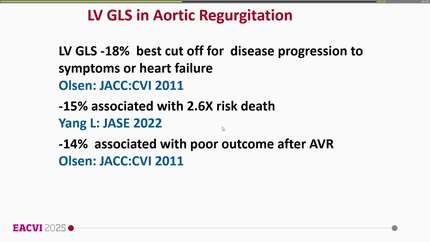
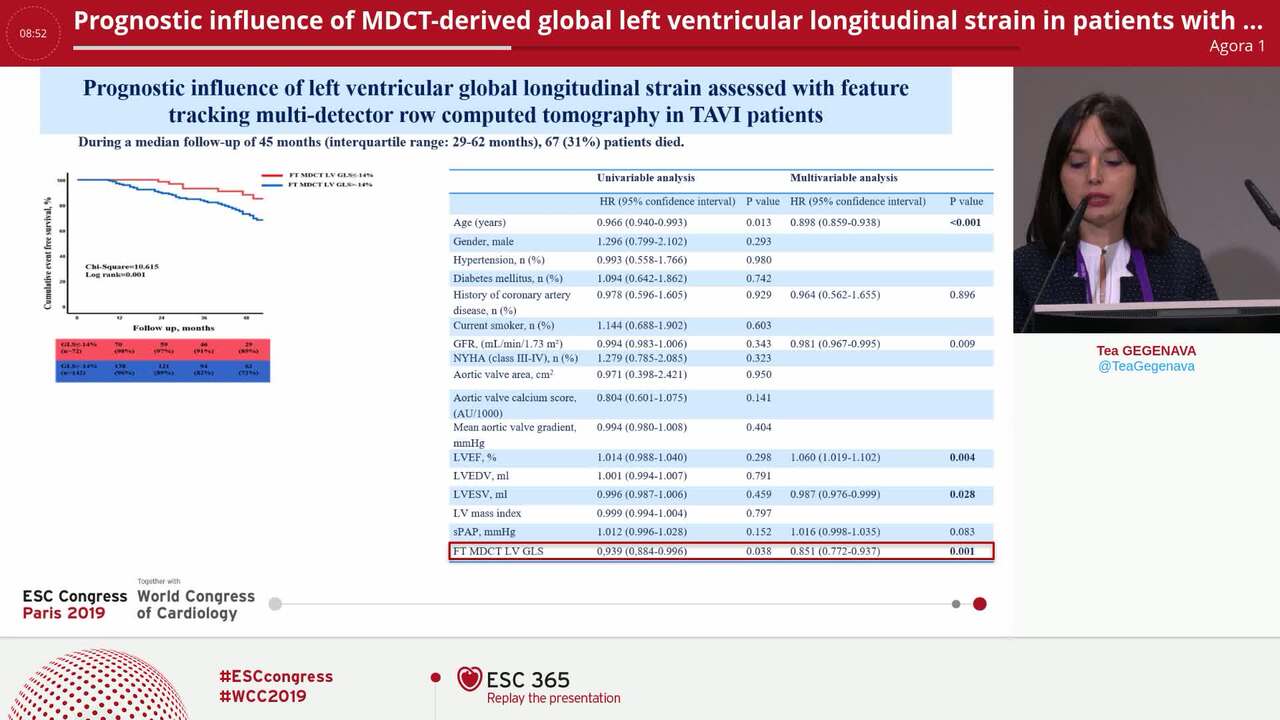
Left ventricular global longitudinal strain improves risk stratification in chronic aortic regurgitation
European Heart Journal - Cardiovascular Imaging


Abstract
To evaluate the prognostic value of cardiac magnetic resonance (CMR) feature tracking-derived left ventricular global longitudinal strain (FT-LVGLS) for adverse outcomes in patients with chronic moderate to severe aortic regurgitation (AR), and to further assess its incremental prognostic value in predicting adverse outcomes beyond the 2025 ESC/EACTS Class I/IIb surgical indication parameters.
This retrospective cohort study initially screened 707 patients with at least moderate chronic AR who underwent CMR between 2010 and 2024, of whom 385 with no or minimal symptoms (NYHA class I–II; mean age 54.1 ± 13.5 years; 329 male) constituted the primary study cohort. The primary endpoint was major adverse cardiac events (MACE), defined as all-cause mortality, heart transplantation, unplanned hospitalization for heart failure, or implantable cardioverter defibrillator discharge. During a median follow-up of 52.9 months, 45 patients experienced MACE. Multivariable Cox regression identified FT-LVGLS as independently associated with MACE (adjusted HR: 1.210 per 1% decrease in absolute FT-LVGLS,
In NYHA class I-II patients with chronic moderate-to-severe AR, FT-LVGLS was independently associated with MACE and provided incremental prognostic value beyond ESC/EACTS guideline-based surgical indication parameters, supporting its potential role in improving risk identification.
Contributors

Bo Li
Author
Yujie Liu
Author
Linlin Dai
Author
Yucong Zheng
Author
Zijuan Han
Author
Yun Tang
Author
Xingrui Chen
Author
Aoxiang Zhang
Author
Xuan Ma
Author
Pengyu Zhou
Author
Xi Jia
Author
Wenqing Xu
Author
Kaisaierjiang Aisikaier
Author
Shengyao Han
Author
Fen Sa
Author
Kai Yang
Author
Kankan Zhao
Author

Xiuyu Chen
Author
Shihua Zhao
Author
State Key Laboratory of Cardiovascular Disease, Fuwai Hospital, National Center for Cardiovascular D Beijing , China
You may be interested in