What is the mechanism of chronic threshold elevation after His-bundle pacing? A histopathological case report suggesting the involvement of fibrin fibrosis
European Heart Journal - Case Reports


Abstract
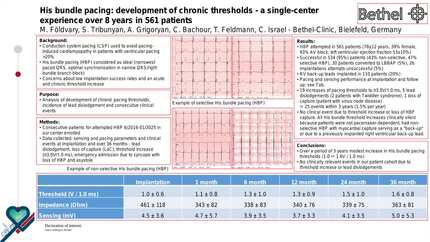
His-bundle pacing (HBP) enables physiological ventricular activation and has been associated with superior clinical outcomes compared with conventional pacing. Nevertheless, chronic threshold elevation remains a major limitation, often leading to early battery depletion or lead revision. The pathological mechanisms underlying chronic threshold elevation have not been fully elucidated.
A 76-year-old man with symptomatic 2:1 atrioventricular block underwent successful HBP implantation, achieving selective His-bundle capture. One week after implantation, both His-bundle and right ventricular pacing thresholds increased markedly. Although the His-bundle capture threshold transiently improved during follow-up, it deteriorated again by 1 year and stabilized. After 5 years and 5 months, early battery depletion prompted extraction of the ventricular lead and re-implantation using left bundle branch pacing. Histopathological examination of the extracted lead tip revealed fibrin-rich tissue with fibroblast proliferation and CD31-positive microvessels. Numerous CD68-positive macrophages were present at the lead–tissue interface. No myocardial or conduction system tissue was identified, which may be consistent with development of a physical barrier between the lead tip and the His-bundle.
This case raises the hypothesis that early fibrin deposition followed by organization may contribute to chronic HBP threshold elevation by increasing the separation between the lead tip and the His-bundle. We speculated that fibrotic tissue interposed between the screw and the His-bundle progressively enlarged, leading to micro-dislodgement and subsequent threshold elevation. To our knowledge, this is one of the first reports describing the histopathological findings of a case with chronic threshold deterioration following HBP.
Contributors

Kenji Baba
Author
Shogo Sakamoto
Author
Moritoshi Irishio
Author
Toru Kataoka
Author
Daiju Fukuda
Author
Fabian Barbieri
Author
Ugur Canpolat
Author
Christine Mages
Author
Armen Kocharian
Author
Lorenzo Caratti di Lanzacco
Author
Deepti Ranganathan
Author
You may be interested in