Bundle branch re-entry ventricular tachycardia mimicking outflow-tract tachycardia: a case report
European Heart Journal - Case Reports


Abstract
Bundle branch re-entrant ventricular tachycardia (BBRVT) is a macro-re-entrant tachycardia involving the His–Purkinje system and is diagnosed by electrophysiologic study. However, atypical ventricular breakout may produce an electrocardiographic pattern mimicking ventricular tachycardia (VT) from right ventricular outflow tract (RVOT), resulting in misdiagnosis.
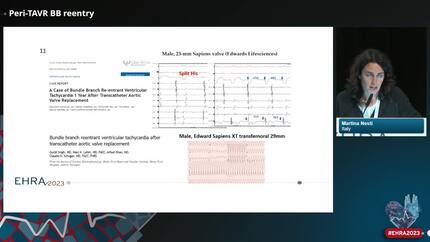
A 66-year-old woman with previous myocardial infarction presented with palpitation and sustained wide-complex tachycardia, left bundle branch block morphology, and an inferior axis, initially suggesting RVOT VT. During electrophysiological study, RVOT mapping failed to identify local ventricular electrograms preceding the QRS complex, and pace mapping was suboptimal. Detailed right ventricular mapping demonstrated that a discrete His potential consistently preceded every ventricular QRS complex during tachycardia. His–His interval changes preceded and predicted subsequent ventricular–ventricular interval changes. Entrainment from the right ventricular apex demonstrated a post-pacing interval minus tachycardia cycle length of 28 ms. These criteria supported BBRVT. Three-dimensional right ventricular activation mapping showed the earliest ventricular breakout at the sub-RVOT anteroseptal region, preceding activation at the right ventricular apex (the common breakout of BBRVT). This proximal septal breakout likely reflected faster conduction through the preserved septal branch than through the impaired distal right bundle branch (RBB). Radiofrequency ablation along the RBB region terminated the tachycardia. The patient remained free from recurrent VT during 6-month follow-up.
BBRVT may mimic RVOT VT when the ventricular breakout occurs at a sub-RVOT anteroseptal region. Not all ventricular arrhythmias with an RVOT-pattern ECG are focal and idiopathic.
Contributors

Khuong Dang Tran
Author
Dung The Bui
Author
Nhut Minh Nguyen
Author
Niklas Schenker
Author
Marco Tomasino
Author
Nikesh Jathanna
Author
Deepti Ranganathan
Author
You may be interested in