New sheathless supra-aortic pulsatile mechanical support via subclavian access for combined protected percutaneous coronary intervention and transcatheter aortic valve implantation in hostile vascular disease: a case report
European Heart Journal - Case Reports


Abstract
The combination of severe aortic stenosis, complex multivessel coronary artery disease and severe left ventricular systolic dysfunction represents a procedural challenge in which coronary revascularization and transcatheter aortic valve implantation (TAVI) must be carefully integrated. Mechanical circulatory support (MCS) indication and selection are crucial when extensive peripheral arterial disease limits conventional large-bore access and when interaction with valve deployment must be avoided.
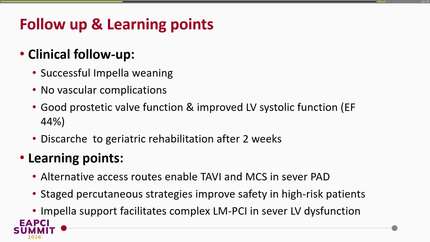
An 84-year-old man was admitted to our intensive cardiac care unit with acute decompensated heart failure. Echocardiography showed severely reduced left ventricular ejection fraction (15%) and severe aortic stenosis (mean gradient 41 mmHg; aortic valve area by velocity-time integral 0.45 cm2). Coronary angiography revealed critical stenoses of the left main (LM), proximal and mid left anterior descending artery (LAD), and ostial and proximal right coronary artery (RCA). Computed tomography revealed extensive aorto-iliac thrombosis, narrow sinotubular junction and short valve-to-coronary distances. Following Heart Team discussion, a combined strategy was adopted. After percutaneous transluminal angioplasty of right iliac artery from right femoral access, sheathless pulsatile MCS (iVAC-2L) was implanted percutaneously via left subclavian access and positioned above the aortic leaflets. Protected percutaneous coronary intervention (PCI) of LM–LAD was then performed. Transcatheter aortic valve implantation with a balloon-expandable valve followed and RCA PCI was subsequently completed. Mechanical circulatory support was maintained throughout all phases.
The new sheathless pulsatile MCS provides haemodynamic stabilization, reduces access profile compared with the previous generation of the device and enables integration of complex PCI and transfemoral TAVI in patients with hostile vascular anatomy.
Contributors

Edoardo Elia
Author
Marco Lombardi
Author
Giovanni La Malfa
Author
Giuseppe Patti
Author
Gioel Gabrio Secco
Author
Josip Andelo Borovac
Author
Oswaldo Aldana Varela
Author
Shaheen Ahmad
Author
Elias Noel Andrade-Cuellar
Author
Deepti Ranganathan
Author
You may be interested in