Ruptured sinus of Valsalva aneurysm mimicking infective endocarditis in a patient with Down syndrome: case report
European Heart Journal - Case Reports


Abstract
Sinus of Valsalva aneurysm is a rare structural anomaly that could be congenital or acquired, usually silent until the moment of rupture. Its diagnosis can be challenging as the turbulent jet flow may mimic vegetations or abscesses associated with infective endocarditis (IE).
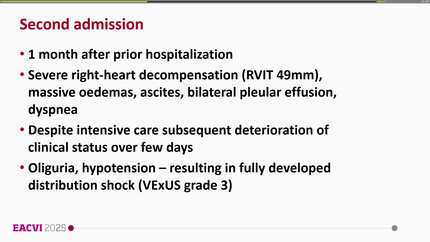
A 31-year-old woman with Down syndrome presented with signs of severe right heart failure and a history of recurrent fevers. Initial echocardiography revealed a massive left-to-right shunt and an echogenic structure in the aortic root, raising suspicion of a paravalvular abscess—patient was treated initially with intravenous antibiotics. However, due to negative blood cultures and imaging findings (coronary computed tomography and cardiac magnetic resonance), lesion was reclassified as a ruptured non-coronary sinus of Valsalva aneurysm (RSOV) fistulizing into the right atrium (Qp:Qs 3.5). Due to the ambiguity of the diagnosis and initial clinical stability, elective surgery was planned after antibiotics course was completed and heart failure treatment optimalization. One month later, the patient presented with acute heart failure event with distribution shock. Emergency surgery was performed. Intraoperative findings confirmed RSOV without signs of infection. The aneurysm was excised with fistula closure, and the aortic valve replaced. The patient made a full recovery.
This case highlights the diagnostic overlap between RSOV and IE. It underscores the critical role of multimodality imaging in excluding infection and defining anatomy. Furthermore, it demonstrates that in cases of massive left-to-right shunting, delaying surgery carries a high risk of rapid haemodynamic collapse.
Contributors


Julia Sekuła
Author
Paweł Żurek
Author

Wojciech Wojakowski
Author
School of Medicine in Katowice, Medical University of Silesia Katowice , Poland
Ewa Peszek-Przybyła
Author
Jan Henzel
Author
Erica Tirr
Author
Alessandro Palmieri
Author
Deepti Ranganathan
Author
You may be interested in