A concealed left-sided accessory pathway with nodoventricular conduction features: a case report
European Heart Journal - Case Reports


Abstract
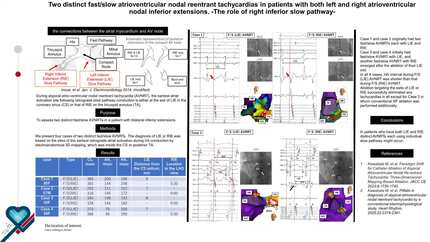
Nodoventricular accessory pathways are rare connections between the atrioventricular (AV) node and ventricular myocardium, typically exhibiting decremental conduction and often mimicking AV nodal re-entrant tachycardia. Their diagnosis remains challenging, particularly in the absence of manifest pre-excitation.
A 30-year-old male with recurrent paroxysmal supraventricular tachycardia (SVT) underwent an electrophysiological study. Electrocardiogram showed no pre-excitation. Pacing manoeuvres revealed concentric, decremental ventriculoatrial conduction, with no evidence for dual AV conduction. Adenosine induced complete anterograde and retrograde block. The tachycardia is induced during programmed atrial stimulation with eccentric coronary sinus activation. The tachycardia is terminated during ventricular overdrive pacing by a fusion beat as well as ventricular extrastimulation without atrial capture in a transition zone, which supports the diagnosis of a nodoventricular accessory pathway with left-sided extension participating in orthodromic AV re-entrant tachycardia. A successful ablation was done on the left posterolateral aspect of the mitral annulus with no further tachycardia induction.
Nodoventricular accessory pathways remain an important but often concealed cause of SVT. This case highlights a rare presentation involving left-sided extension and demonstrates how detailed electrophysiological assessment can distinguish this entity from other tachycardias. Consideration of this mechanism is essential to ensure accurate diagnosis and safe therapeutic decision-making.
Contributors


Moneeb Khalaph
Author


Felix Wiedmann
Author
Vera Maslova
Author
Nibras Soubh
Author
Deepti Ranganathan
Author
You may be interested in