Usability, user experience and acceptability of the aktivplan digital intervention for regular physical activity following phase II rehabilitation: further findings from the ACTIVE-CaRe Pilot study
European Journal of Cardiovascular Nursing


Abstract
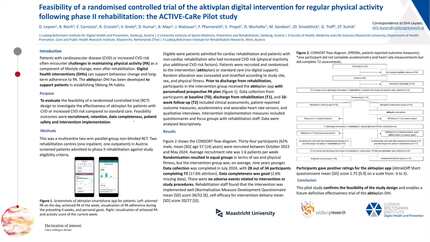
Usability and user experience of digital health interventions (DHIs) are important for user engagement and adherence. The aktivplan DHI [1,2] has been developed to support cardiovascular disease (CVD) prevention through establishing physical activity (PA) habits following a phase II rehabilitation programme. From October 2023 until August 2024, aktivplan was investigated in a feasibility randomised controlled trial (ACTIVE-CaRe Pilot).
This abstract presents findings from the ACTIVE-CaRe Pilot study concerning usability, user experience and adherence of the aktivplan DHI. Outcomes were standardised questionnaires and qualitative interviews on usability, user experience and acceptability of the aktivplan DHI; and self-reported adherence to the PA plan.
Prior to discharge from phase II rehabilitation, 16 participants (62,5% male, mean [SD] age 52 [15] years) received the aktivplan DHI with a personalised prospective PA plan (fig. 1). The participants either had an established diagnosis of CVD or risk factors for CVD. Following discharge, participants used aktivplan for 10 weeks. At baseline, participants completed the Affinity for Technology Interaction (ATI) scale. During the study period, participants reported their adherence to the PA plan in the aktivplan app. At the 10-week follow-up, participants completed the Unified Theory of Acceptance and Use of Technology questionnaire version 2 (UTAUT-2), Mobile App Rating Scale functionality subscale (MARS-F), mHealth App Usability Questionnaire (MAUQ) and a qualitative interview. Quantitative data were analysed descriptively. Qualitative data were analysed by framework analysis.
The participants had moderate affinity for technology (median 4.0, range 1.8-5.6, scale range 1-6 with higher values indicating greater affinity). They completed on average (median, range) 82% (1-100%) of their planned PA sessions and 20 (0-124) additional (unplanned) PA sessions. A question on how supportive aktivplan was for PA adherence was rated with a median (range) of 5 (3-5, scale rage 1-5 with higher values indicating greater support). Results of the UTAUT-2, MARS-F and MAUQ questionnaires are presented in table 1, indicating overall good user acceptance, perceived quality, impact and usability.
Qualitative data corroborate the quantitative findings. Most participants attested to the easy use of the aktivplan app. Some suggestions for technical improvements and additional features were made, including a direct communication channel to the rehabilitation professional and flexibility in rescheduling the planned PA sessions. Some participants commented that aktivplan supported their motivation for PA, and about half stated that they would use the app over a longer period.
This study demonstrates good usability and user experience of the aktivplan DHI. Good adherence rates indicate that the intervention holds promise for supporting regular PA in CVD prevention.
Contributors

B Reich
Author
E Carrozzo
Author
R Crutzen
Author
V Grote
Author
B Mayr
Author
J Niebauer
Author
F Pfannerstill
Author
E M Bamberger
Author
D Wurhofer
Author
M Sareban
Author
J D Smeddinck
Author
G Treff
Author
S T Kulnik
Author
You may be interested in