Anticipating tomorrow: how patient-reported outcomes relate to expectations about future health in adults with congenital heart disease from 32 countries
European Journal of Cardiovascular Nursing


Abstract
Patient-reported outcomes (PROs) provide important insights into patients’ perspectives on living with their health conditions. PROs can be influenced by care already received, and may also shape patients’ expectations regarding future health. This is particularly relevant for individuals with chronic and lifelong conditions, such as congenital heart disease (CHD)
To explore relationships between PROs and level of concern adults with CHD have about their future health.
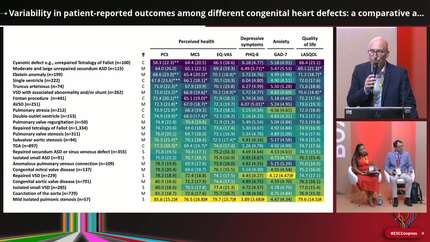
This study is part of the ‘Assessment of Patterns of Patient-Reported Outcomes in Adults with Congenital Heart disease – International Study II’ (APPROACH-IS II), an international cross-sectional investigation conducted in 32 countries across six continents. A total of 8,224 adults with CHD were enrolled (mean age 35.5y [SD: 13.5]; 54% women). PROs included perceived health status measured using the RAND-12 Health Survey (Physical Component Summary [PCS] and Mental Component Summary [MCS]) and the EuroQOL-5D Visual Analog Scale (EQ-VAS); depressive symptoms assessed with the Patient Health Questionnaire-8 (PHQ-8); anxiety measured using the General Anxiety Disorder-7 (GAD-7) and quality of life measured using a Linear Analog Scale (LASQOL). For the present study, we focused on one item from the assessment of advance care planning needs: "On a scale from 0 to 10, how concerned are you about your health in the future?" Bivariate analyses were conducted using Pearson correlation coefficients. Non-linearity was examined using restricted cubic splines with 4 knots.
Participants’ mean score for concern about their future health was 5.6 (SD: 2.9). This value was statistically significantly correlated (p<0.001) with all PROs: PCS (r=−0.332), MCS (r=−0.292), EQ-VAS (r=−0.293), PHQ-8 (r=0.257), GAD-7 (r=0.264), and LASQOL (r=−0.250). Visual inspection of the cubic splines (Fig 1) suggested that the relationships exhibited predominantly non-linear characteristics.
Greater concern about future health was associated with lower physical and mental health status and quality of life and higher depression and anxiety symptoms. The cross-sectional design of this study, however, does not allow to draw conclusions about the direction of effect. The observed associations were non-linear, indicating that the strength of the relationships varied across the range of PRO levels.
Contributors



You may be interested in