Catdol study: local analgesic pretreatment and pain during radial or ulnar arterial access
European Journal of Cardiovascular Nursing


Abstract
There is currently no standardised protocol for topical analgesic pretreatment prior to subcutaneous local anaesthetic administration for radial or ulnar arterial access. Although arterial cannulation is minimally invasive, patients frequently experience pain and procedural stress. To evaluate the effectiveness of two topical analgesic pretreatment strategies in reducing pain perception during subcutaneous local anaesthetic injection and arterial introducer placement.
A prospective observational study was conducted including three treatment groups: analgesic ointment (71 patients, 33.0%), cold spray (74 patients, 34.4%) and no topical analgesic pretreatment (control group; 70 patients, 32.6%). Patients were consecutively included as they arrived for routine nursing care prior to catheterisation. Pain intensity was assessed using the visual analogue scale (VAS, 0–10). Demographic (age, sex) and clinical variables potentially influencing pain perception, including cardiovascular risk factors, cardiac history and treatments, were recorded.
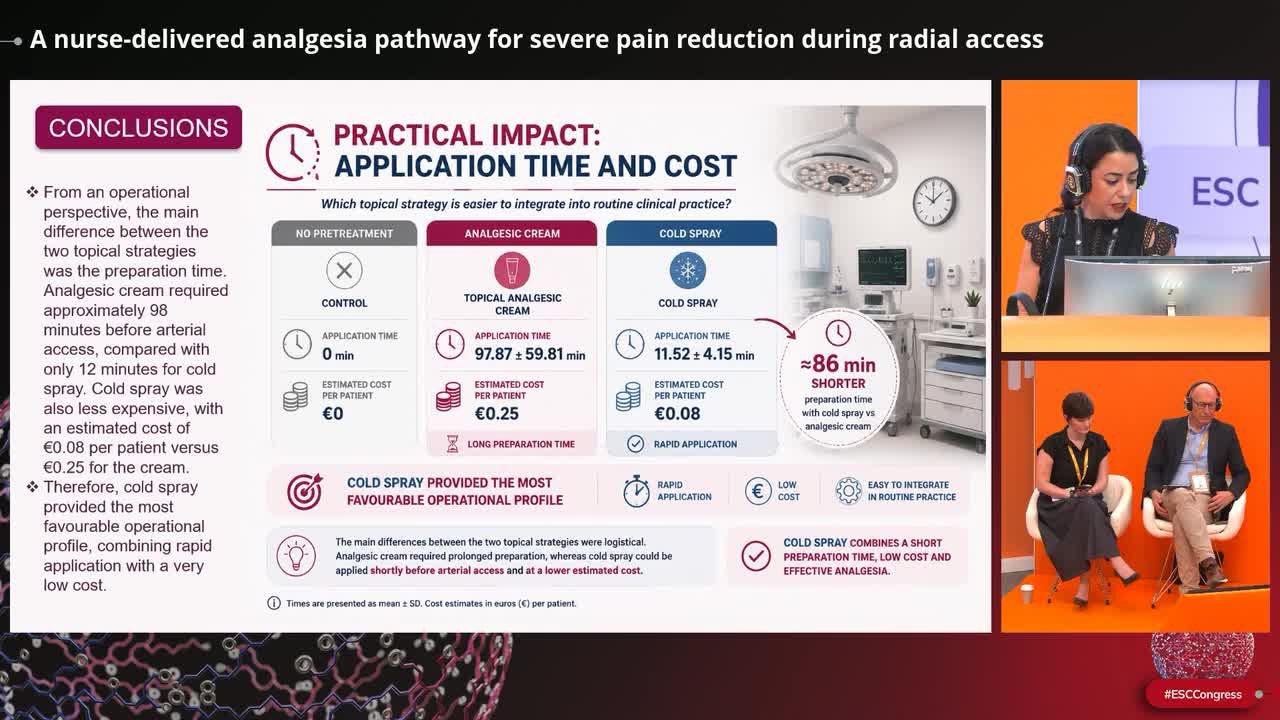
Between August 2024 and January 2025, 215 patients were included: 60 women (28%), mean age 68.1±12.9 years, and 155 men (72%), mean age 65.0±12.6 years. Mean VAS pain scores at time point 1 were 3.61 in the analgesic ointment group, 3.12 in the cold spray group and 4.37 in the control group. Topical analgesic pretreatment was associated with a significant reduction in pain compared with the control group at both time point 1 (after local anaesthetic injection) and time point 2 (after arterial introducer placement). At time point 1, cold spray was associated with a mean reduction of −1.25 VAS points compared with the control group (95% CI −1.8 to −0.7; p<0.0001). Severe pain (VAS ≥6) was reported in 28 patients (13.0%): 17 (60.7%) in the control group, 7 (25.0%) in the analgesic ointment group and 4 (14.3%) in the cold spray group. The mean time from pretreatment administration to arterial puncture was 97.8±59.1 minutes for analgesic ointment and 11.5±4.1 minutes for cold spray. No significant association was observed between VAS pain intensity and age, sex, diabetes or other recorded clinical variables
Topical analgesic pretreatment with analgesic ointment or cold spray is associated with a significant reduction in pain at time points 1 and 2 compared with no pretreatment. Cold spray represents the fastest option and is associated with lower costs. Pain intensity at two time points Secondary outcomes
Contributors


You may be interested in