Choosing a frailty measure that works: comparing practicality and tool agreement in heart failure patients
European Journal of Cardiovascular Nursing


Abstract
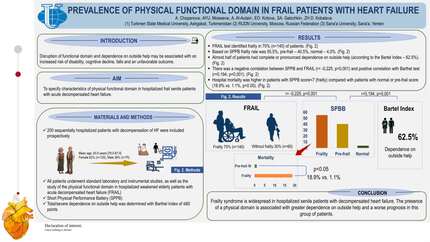
Physical frailty is a common comorbidity in patients hospitalised with heart failure (HF)(1), yet it is not routinely measured at discharge. Given its impact on outcomes and its relevance to tailoring HF management and rehabilitation, incorporating frailty assessment into clinical practice is important(2). The Fried phenotype is the most commonly used tool in cardiovascular populations but requires objective testing, which may be difficult to implement in routine settings. This sub-study compared three frailty tools in patients with HF at hospital discharge: the Fried phenotype(3) and the Short Physical Performance Battery (SPPB)(4), both requiring direct physical testing, and the FRAIL Scale(5), a self-reported questionnaire suitable for in-person or remote use.
The objective was to evaluate agreement between these frailty tools in identifying physically frail patients, to support evidence-based selection of assessment methods for clinical practice. Ethical approval was obtained from the appropriate committee.
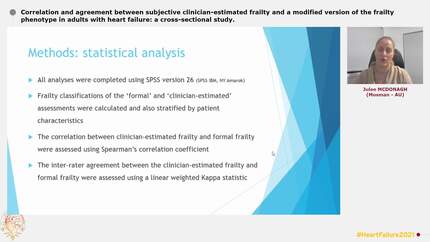
This was a sub-study of a UK prospective single-centre observational study of adults admitted with acute decompensated HF between April 2021 and June 2022. Recruitment was via inpatient HF nursing or ward staff, with verbal consent obtained before assessment of eligibility. Participants had chronic HF, an admission for acute decompensated heart failure, and were considered suitable for referral to cardiac rehabilitation. Frailty was assessed at discharge (±7 days) and again six weeks later using the Fried phenotype, SPPB, and FRAIL Scale. Agreement in identifying frailty was analysed using Cohen’s kappa (κ), with Fried as the reference standard.
Complete data for all three measures were available for 30 participant contacts. The Fried phenotype classified 17% as non-frail, 30% as pre-frail, and 53% as frail. Agreement between the FRAIL Scale and Fried phenotype was fair (κ = 0.40 CI +/- 0.22; p = <.001; 60% agreement). Agreement between the SPPB and Fried phenotype was lower and not statistically significant (κ = 0.22 CI +/- 0.26; p = .087 50% agreement). Confidence intervals were wide, reflecting the small sample size. The FRAIL Scale’s simplicity and suitability for remote use supported its feasibility for repeated assessment during early recovery.
Frailty tools identified different patient groups, underscoring the complexity of measuring frailty in HF. The FRAIL Scale showed moderate agreement with the Fried phenotype but was far easier to use in routine clinical practice. Its practicality suggests value for screening, yet further research is required to confirm its accuracy in HF populations and its ability to track changes in frailty over time.
Contributors

H Waterhouse
Author
University of Leicester Leicester , United Kingdom of Great Britain & Northern Ireland

S Singh
Author

I Squire
Author
University of Leicester Leicester , United Kingdom of Great Britain & Northern Ireland
You may be interested in