Higher pneumococcal vaccine uptake in women than men with heart failure: age-adjusted findings from a telemonitoring survey
European Journal of Cardiovascular Nursing


Abstract
Heart failure (HF) patients are prioritized for adult vaccines, yet coverage remains suboptimal. Sex-related differences in preventive care pathways may contribute to gaps, and telemonitoring programmes could support targeted reminders. Understanding sex patterns may inform implementation strategies.
In November 2025, we performed a cross-sectional, self-administered survey among HF patients enrolled in the Satelia® Cardio telemonitoring programme in France. Participants reported vaccination knowledge and attitudes and self-reported status for five vaccines: seasonal influenza (this season), seasonal COVID-19 booster (this season), pneumococcal, diphtheria–tetanus–polio–pertussis booster (DTPC), and herpes zoster. We compared women and men using chi-square tests and estimated age-adjusted odds ratios (aOR) from logistic regression models.
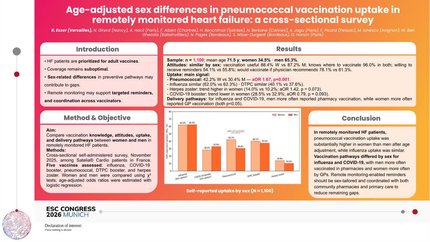
Among 1,100 respondents (mean age 71.5 years), 379 were women (34.5%) and 718 men (65.3%) (sex not specified: 3). Vaccination was considered useful by 88.4% of women and 87.2% of men, and 96.0% of women and 96.0% of men reported knowing where to get vaccinated. Willingness to receive reminders from Satelia or the care team was similar (54.1% in women vs 55.8% in men). If vaccination was recommended by their physician, 78.1% of women and 81.3% of men reported they would get vaccinated (unsure: 17.7% vs 14.1%; no: 4.2% vs 4.6%). Self-reported influenza coverage was similar by sex (62.0% women vs 62.3% men). Pneumococcal vaccination was higher in women (42.2% vs 30.4%; p<0.001), remaining significant after age adjustment (aOR 1.67, p<0.001). DTPC coverage did not differ (40.1% vs 37.6%). Women tended to report higher herpes zoster vaccination (14.0% vs 10.2%; aOR 1.42, p=0.073) and lower seasonal COVID-19 booster uptake (28.5% vs 32.9%; aOR 0.79, p=0.093). Vaccination pathways differed modestly: men more frequently reported pharmacy vaccination for influenza and COVID-19, whereas women more often reported general practitioner vaccination (both p<0.05).
In telemonitored HF patients, pneumococcal vaccination uptake was substantially higher in women than men, while influenza uptake was similar. Sex differences in vaccination pathways suggest that telemonitoring-enabled reminders and coordination with both community pharmacies and primary care could be tailored to close remaining gaps locally.
Contributors



F Albert
Author
H Benchimol
Author
N Berkane
Author
A Jagu
Author
M Ionescu
Author
J Bellony
Author
W Ben Ghezala
Author
N Pages
Author

O Hanon
Author
You may be interested in