Targeting vaccine gaps across the lifespan in heart failure: age-stratified uptake of five adult vaccines in a telemonitoring programme
European Journal of Cardiovascular Nursing


Abstract
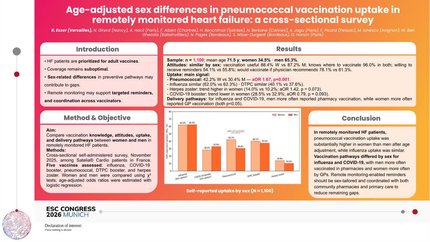
Heart failure (HF) patients are prioritized for several adult vaccines, yet uptake is heterogeneous and may vary by age. Telemonitoring programmes could enable age-tailored reminders. We assessed patterns in vaccine knowledge, intention, and self-reported uptake in an HF cohort.
Cross-sectional, self-administered survey among HF patients enrolled in the Satelia® Cardio remote monitoring programme in France in November 2025. Participants reported knowledge/attitudes and self-reported status for seasonal influenza and COVID-19 booster (this season), pneumococcal, DTPC booster, and herpes zoster vaccination. Outcomes were described across age groups (18–49, 50–64, 65–74, 75–84, ≥85 years).
Among 1,100 respondents (mean age 71.5 years), age distribution was 18–49: 5.5%, 50–64: 22.7%, 65–74: 27.1%, 75–84: 29.3%, and ≥85: 15.5%. Knowledge of age-recommended vaccines increased from 40.0% (18–49) to ~80% from 65 years onward, and perceived usefulness rose from 78.3% to 92.9%; knowing where to get vaccinated increased from 85.0% to 98.2%. Reported access difficulties were uncommon and declined with age (5.0% to 0.0%). Self-reported influenza uptake rose with age (35.0% in 18–49 to 71.8% in ≥85). Seasonal COVID-19 booster uptake showed a steeper gradient (8.3% to 42.4%). Pneumococcal vaccination peaked in 65–74 years (43.3%) compared with 20.0% in 18–49 and 28.8% in ≥85. DTPC uptake was higher in younger groups and declined after 75 years (43.3% in 18–49 vs ~35% in ≥75). Herpes zoster vaccination remained low overall, <5% below 65 years and ~14–15% from 65 years onward. Interest in programme reminders decreased in the oldest group (61.7% in 18–49 vs 47.6% in ≥85).
Vaccination uptake in remotely monitored HF patients displayed distinct age-patterns: strong gradients for influenza and seasonal COVID-19 booster, a mid-older peak for pneumococcal vaccination, and persistently low herpes zoster uptake. Remote monitoring programmes may support age-tailored strategies—prioritizing younger HF patients for influenza/COVID prompts, mid-older groups for pneumococcal catch-up, and older adults for DTPC/zoster gap reduction—while addressing engagement barriers in the oldest patients.
Contributors



N Berkane
Author
H Benchimol
Author
F Albert
Author
A Jagu
Author
M Ionescu
Author
J Bellony
Author
W Ben Ghezala
Author
N Pages
Author

O Hanon
Author
You may be interested in