Effectiveness and safety of treatment for heterozygous familial hypercholesterolaemia and multifactorial dyslipidaemia in children: an overview of systematic reviews
European Journal of Preventive Cardiology


Abstract
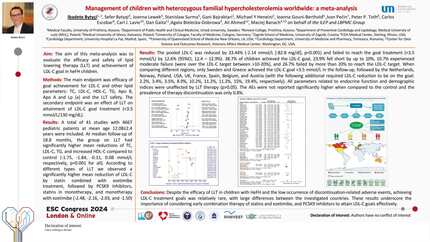
This overview of systematic reviews (SRs) summarizes evidence on effectiveness and safety of treatment for paediatric heterozygous familial hypercholesterolaemia (heFH) and multifactorial dyslipidaemia (MFD).
MEDLINE, EMBASE, Cochrane, and Epistemonikos were systematically searched for relevant SRs of randomized controlled trials (RCTs) published 01.01.2015-16.05.2024, with updated search until 31.01.2025. Systematic reviews on different therapeutic interventions assessing surrogate and long-term health outcomes were eligible. AMSTAR-2 was used to appraise SRs and GRADE to evaluate certainty of evidence (CoE). Eight SRs were included and high-quality ones prioritized for further analysis. Among children with heFH, in a meta-analysis of six RCTs (
In summary, statins are effective lipid-lowering therapy in paediatric FH, with long-term safety requiring further investigation. Evidence evaluating non-pharmacological interventions for childhood dyslipidaemia is sparse.
Contributors

Thu Giang Le Thi
Author
Milena Geist
Author
Yuliia Novosad
Author
Anna Litwin
Author
Delphina Gomes
Author
Juliane Grünzner
Author
Berthold Koletzko
Author
Bernadeta Patro-Golab
Author
You may be interested in