Prediction of appropriate implantable cardioverter-defibrillator therapy using machine learning and routinely available clinical data
European Heart Journal - Digital Health


Abstract
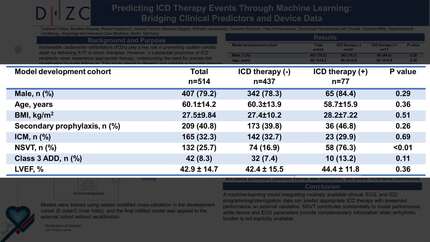
Risk stratification for appropriate implantable cardioverter-defibrillator (ICD) therapy remains imprecise when based on conventional clinical variables alone. We aimed to develop and geographically validate a machine-learning model that integrates routinely available clinical, electrocardiogram, and device interrogation/programming parameters, and quantify the incremental value of non-sustained ventricular tachycardia (NSVT).
We retrospectively analysed 514 ICD recipients implanted between 2020 and 2025 at two hospital sites (development cohort) and an independent cohort of 220 patients from a third site (external validation). The endpoint was appropriate ICD therapy (anti-tachycardia pacing or shock). Models were trained using nested stratified cross-validation in the development cohort, and the final refitted model was applied to the external cohort without recalibration. In the development cohort, 77/514 patients (15%) experienced appropriate ICD therapy (follow-up 404 days). A base model (histogram-based gradient boosting) excluding NSVT achieved modest discrimination [receiver operating characteristic (ROC)-area under the curve (AUC) 0.624; average precision 0.198]. Adding NSVT improved performance (ROC-AUC 0.805; average precision 0.432). Logistic regression with NSVT achieved comparable discrimination (ROC-AUC 0.78; average precision 0.43), indicating a largely NSVT-driven gain. External validation (event rate 51/220, 23%) confirmed good discrimination (ROC-AUC 0.815; average precision 0.583) with acceptable calibration (Brier score 0.137). At the pre-specified threshold of 0.16 in external validation, sensitivity was 0.78 and specificity was 0.74.
A machine-learning model integrating routinely available clinical, electrocardiogram, and ICD programming/interrogation data may enable the prediction of appropriate ICD therapy with preserved performance on geographic external validation. NSVT was the dominant contributor to predictive performance across modelling approaches.
Contributors

Toshinori Chiba
Author
Serafina Wegner
Author

Verena Tscholl
Author
Robert Haettasch
Author
Patrick Nagel
Author
Johannes Lucas
Author
Nikolaos Dagres
Author
Felix Balzer
Author
Alexander Meyer
Author
Wilhelm Haverkamp
Author
Florian Blaschke
Author
Gerhard Hindricks
Author
You may be interested in