Intra-SVC re-entrant atrial tachycardia successfully treated with a circular multi-electrode array pulsed-field ablation catheter—case report
European Heart Journal - Case Reports


Abstract
The superior vena cava (SVC) is a well-recognized non-pulmonary vein (PV) focus in atrial fibrillation (AF); however, intra-SVC re-entrant atrial tachycardia (AT) is extremely rare.
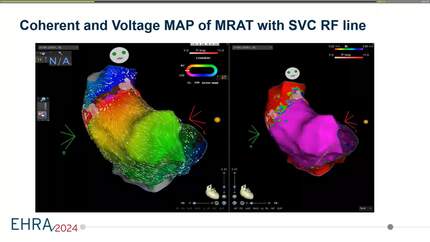
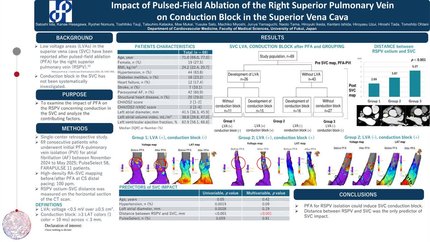
An 83-year-old woman with a history of PV isolation using radiofrequency ablation 1 year earlier was referred for a second ablation due to recurrent AT. Activation mapping of the AT demonstrated a re-entrant circuit involving the left atrial (LA) posterior wall. Because bilateral PVs were reconnected, pulsed-field ablation (PFA), including PV re-isolation and LA posterior wall isolation, was performed using a circular multi-electrode array PFA catheter. The initial PFA application did not terminate the tachycardia; however, the arrhythmia transitioned to a different AT. High-resolution mapping revealed a re-entrant circuit confined within the SVC sleeves, characterized by transverse re-entrant propagation. Entrainment pacing confirmed intra-SVC re-entry. Circumferential PFA was delivered to the SVC during sinus rhythm, achieving SVC isolation without sinus node dysfunction or phrenic nerve palsy.
This case demonstrates effective management of intra-SVC re-entrant AT using a circular multi-electrode PFA catheter. High-resolution mapping identified a rare re-entrant circuit confined to the SVC. Owing to its tissue selectivity, PFA enables safe and effective SVC isolation while minimizing the risk of phrenic nerve injury.
Contributors

Takeru Ikenaga
Author
Hiroshi Mannoji
Author
Nobuhiro Suematsu
Author
Toru Kubota
Author
Stefano Bordignon
Author
Niklas Schenker
Author
Deepti Ranganathan
Author
You may be interested in