Role of interatrial connection ablation in re-entry dynamics: an in silico evaluation
EP Europace Journal


Abstract
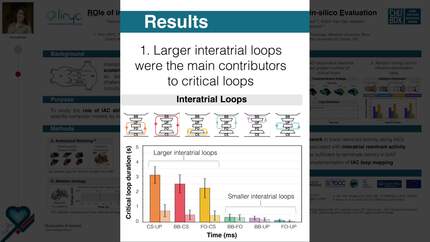
Interatrial connections (IACs) may act as pathways sustaining atrial fibrillation (AF), yet their role as ablation targets remains uncertain due to challenges in identifying IAC-dependent re-entrant circuits. This study tracks re-entrant activity along IACs, characterizes IAC-dependent re-entries, and assesses the impact of in silico IAC ablation on re-entry maintenance.
Six patient-specific biatrial bilayer models were reconstructed from CT and MRI-derived geometries, each incorporating four IACs: Bachmann’s bundle, fossa ovalis, upper posterior, and coronary sinus. The Courtemanche ionic model was used to simulate mild (M) and severe (S) AF-related electrical remodelling, with fibrosis burden ranging from 9.0% (M) to 27.6% (S). Across the 12 models, 110 sustained re-entries were induced, followed by circumferential pulmonary vein isolation. Fifteen IAC ablation strategies were tested at three different timings. Critical pathways along the six possible interatrial loops were quantified. Tachycardia cycle length (TCL) and phase singularity (PS) clusters were analysed before and after IAC ablation. Overall, 11.8% of re-entries were IAC-dependent. Larger interatrial loops were the major contributors to critical pathway formation. IAC-dependent re-entries exhibited more critical pathways, shorter TCL (194.2 vs. 201.9 ms; ΔTCL = 7.65 ms,
We present the first framework to track re-entrant activity along IACs. We identified IAC-dependent re-entry characteristics that may guide patient stratification and targeted ablation strategies in clinical practice.
Contributors


Hamed Hosseini
Author

Carmen Martínez Antón
Author
Carlos López Barrera
Author
Robin Van Den Abeele
Author


Caroline Roney
Author
Queen Mary University of London London , United Kingdom of Great Britain & Northern Ireland
Thomas Pambrun
Author
Mélèze Hocini
Author
Jason Bayer
Author
Edward J Vigmond
Author
You may be interested in