Inclisiran-based treatment strategy in hypercholesterolaemia: the VICTORION-difference trial
European Heart Journal


Abstract
Low-density lipoprotein cholesterol (LDL-C) is a causal risk factor for atherosclerotic cardiovascular (CV) disease development and progression. The European Society of Cardiology guidelines recommend combination treatment to achieve CV risk-based LDL-C treatment goals. Inclisiran, a small interfering ribonucleic acid (siRNA) that targets hepatic proprotein convertase subtilisin/kexin type 9 (PCSK9) messenger RNA, can provide sustained and effective LDL-C reduction.
VICTORION-Difference, a phase 4 double-blind, placebo-controlled randomized clinical trial included adults with hypercholesterolaemia at high- or very high CV risk. Participants were randomized 1:1 to receive inclisiran sodium (300 mg subcutaneous injections; equivalent to 284 mg inclisiran) or placebo together with individually optimized lipid-lowering therapy (ioLLT), including up-titration with rosuvastatin (open-label) until either their individual LDL-C goal or maximally tolerated statin dose (open-label rosuvastatin) was achieved. The primary objective was assessment of LDL-C goal achievement at Day 90. Key secondary objectives were muscle-related adverse events (MRAEs) and mean LDL-C reduction. Overall, 1770 individuals (mean age, 63.7 years) were randomized to receive inclisiran (
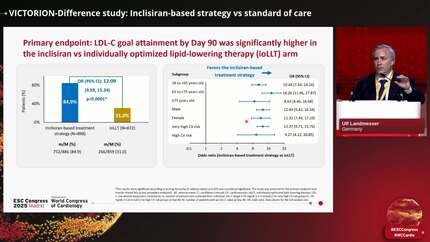
Overall, 1770 individuals (mean age, 63.7 years) were randomized to receive inclisiran (n=898) or ioLLT (n=872). At Day 90, a significantly higher proportion of participants receiving inclisiran vs. ioLLT achieved their individual LDL-C goals (84.9% vs. 31.0%; odds ratio [OR] 12.09, p<0.001). The mean percentage reduction in LDL-C from baseline to Day 360 was -59.5% and -24.3% in the inclisiran and ioLLT arms, respectively (least squares mean treatment difference [LSMTD]=-35.14%, p<0.001). Fewer participants receiving inclisiran vs. ioLLT reported a MRAE (11.9% vs. 19.2%; OR 0.57, p<0.001). The mean reduction in Short Form-Brief Pain Inventory pain severity and interference scores favoured inclisiran over ioLLT (LSMTD=-0.11, p=0.039; LSMTD=-0.11, p=0.029, respectively). No new safety concerns were identified.
An inclisiran-based treatment strategy was superior to ioLLT in LDL-C goal achievement, delivering early and sustained LDL-C reduction, with fewer MRAEs in individuals with hypercholesterolaemia.
Contributors



Ulrike Schatz
Author
Ephraim B Winzer
Author
Bernd Nowak
Author
Ursula Kassner
Author
Ioanna Gouni-Berthold
Author
Alicia Esteban
Author
Lawrence Lubyayi
Author
Andre Krueger
Author
Christian Hentschke
Author
Andreas Wilke
Author
Bernhard R Winkelmann
Author
Assya Achouba
Author

You may be interested in