Transcatheter aortic valve implantation-related acute ascending aortic dissection diagnosed intraoperatively using transoesophageal echocardiography: a case series
European Heart Journal - Case Reports


Abstract
Transcatheter aortic valve implantation (TAVI) has been widely adopted as a less invasive treatment for aortic stenosis (AS). Although rare, acute ascending aortic dissection associated with TAVI is a life-threatening complication that necessitates prompt intraoperative diagnosis. This case series reports two cases of acute ascending aortic dissection occurring during TAVI performed under general anaesthesia.
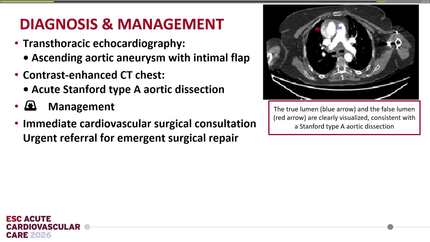
Cases 1 and 2 involved an 87-year-old woman and a 90-year-old man, respectively, both of whom underwent transfemoral TAVI for severe AS. In both cases, procedural difficulty was encountered, including valve pop-up and resistance during device passage. Before overt haemodynamic deterioration became apparent, intraoperative transoesophageal echocardiography revealed an intimal flap and false lumen in the ascending aorta, leading to the diagnosis of acute ascending aortic dissection. Both patients underwent prompt surgical intervention. Case 1 underwent surgical aortic valve replacement (SAVR) and ascending aortic replacement, whereas Case 2 underwent SAVR and total arch replacement. Both patients were discharged ambulatory without neurological sequelae.
Unlike fluoroscopy and angiography, which provide only intermittent assessment, transoesophageal echocardiography enables continuous intraoperative evaluation and can simultaneously detect findings directly relevant to haemodynamic status, including an intimal flap, false lumen, acute aortic regurgitation, and pericardial effusion. This case series suggests that additional transoesophageal echocardiography assessment prompted by procedural difficulty may contribute to the early diagnosis of serious complications and facilitate prompt conversion to surgical intervention.
Contributors

Yuki Makizawa
Author
Atsushi Fujiwara
Author
Takanobu Fujisawa
Author
Yusuke Kusaka
Author
Toshiaki Minami
Author
Stefano Bordignon
Author
Bruno Rocha
Author
Mohammed Shahbaaz Khan
Author
Deepti Ranganathan
Author
You may be interested in