Impact of leadless micra pacemaker on tricuspid regurgitation and clinical outcomes: a single-center experience
EP Europace Journal


Abstract
Leadless pacemakers, such as the Micra™ system, minimize the need for trans-tricuspid leads and are therefore expected to reduce the risk of tricuspid valve dysfunction. However, data on their long-term effect on tricuspid regurgitation (TR) severity and clinical outcomes remain limited.
This study aimed to investigate the potential impact of leadless Micra pacemaker implantation on tricuspid valve function and to examine related clinical outcomes, including heart failure symptoms, hospitalization, and mortality.
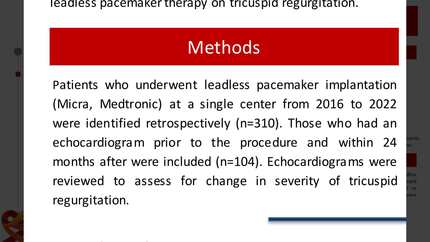
We conducted a single-center, retrospective study including 51 patients who underwent implantation of a leadless Micra pacemaker between 2016 and 2025. Baseline demographic, echocardiographic, and clinical data were collected. Follow-up echocardiography was performed at least three months post-implantation and analyzed for changes in TR severity, and clinical outcomes—including cardiac hospitalization, tricuspid valve intervention, and all-cause mortality—were recorded.
During follow-up, 25 patients (49%) experienced at least one cardiac hospitalization, 7 (14%) died, and 3 (6%) underwent tricuspid valve intervention. Regarding valvular function, 12 patients (24%) showed mild improvement (−1 TR grade), while 9 patients (18%) demonstrated a greater improvement of ≥2 grades. Conversely, 7 patients (14%) experienced worsening of TR by ≥2 grades, and 22 (43%) remained stable. Overall, there was no significant deterioration in average TR grade after Micra implantation.
In this single-center cohort, implantation of a leadless Micra pacemaker was not associated with a clinically significant increase in tricuspid regurgitation severity or adverse cardiac outcomes. Only a small minority exhibited worsening of TR, while most patients remained stable or improved. These findings support the valve-sparing nature of leadless pacing systems and warrant confirmation in larger, prospective studies.
Contributors

H Swartz
Author
J Eisenberger
Author
A Sabbg
Author
E Nof
Author
R Beinart
Author
A Berkovitch
Author
M Katz
Author
You may be interested in