Emergency out-of-hours permanent pacing in frail patients: safe and effective
EP Europace Journal


Abstract
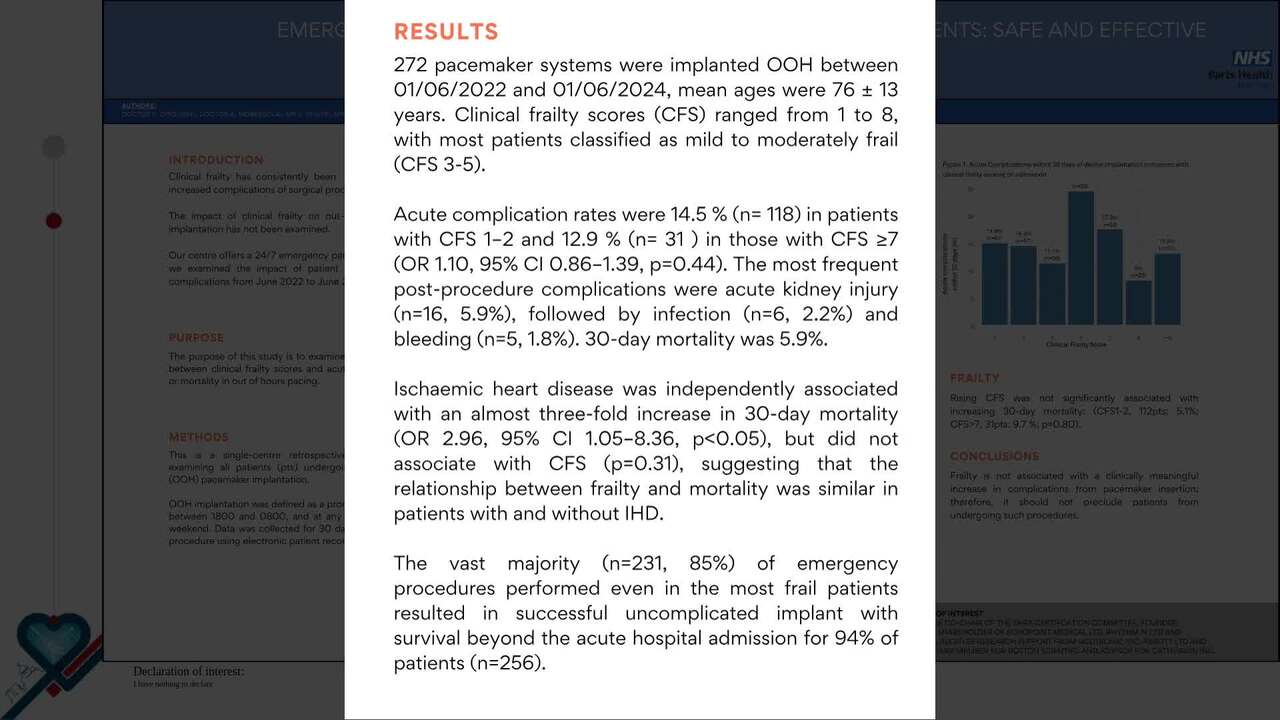
Clinical frailty is associated with increased complications of surgical procedures. The impact of clinical frailty on out-of-hours pacing implantation has not been examined. Our centre offers a 24/7 emergency pacing service, and we examined the impact of patient frailty on acute complications from June 2022 to June 2024.
The purpose of this study is to examine the relationship between clinical frailty scores and acute complications or mortality in out of hours pacing.
This is a single-centre retrospective cohort study examining all patients (pts) undergoing out-of-hours (OOH) pacemaker implantation. OOH implantation was defined as a procedure start time between 1800 and 0800, and at any time during the weekend. Clinical Frailty scores, complications within 30 days and mortality within 30 days were retrospectively collected using electronic patient records.
272 pacemaker systems were implanted OOH between 01/06/2022 and 01/06/2024, mean ages were 76 ± 13 years. Clinical frailty scores (CFS) ranged from 1 to 8, with most patients classified as mild to moderately frail (CFS 3-5). Acute complication rates were 14.5 % (n= 118 ) in patients with CFS 1–2 and 12.9 % (n= 31 ) in those with CFS ≥7 (OR 1.10, 95% CI 0.86–1.39, p=0.44). The most frequent post-procedure complications were acute kidney injury (n=16, 5.9%), followed by infection (n=6, 2.2%) and bleeding (n=5, 1.8%). 30-day mortality was 5.9%.
Rising CFS was not significantly associated with increasing 30-day mortality: (CFS1-2, 112pts: 5.1%; CFS>7, 31pts: 9.7 %; p=0.80).
Ischaemic heart disease was independently associated with an almost three-fold increase in 30-day mortality (OR 2.96, 95% CI 1.05–8.36, p<0.05), but did not associate with CFS (p=0.31), suggesting that the relationship between frailty and mortality was similar in patients with and without IHD.
The vast majority (n=231, 85%) of emergency procedures performed even in the most frail patients resulted in successful uncomplicated implant with survival beyond the acute hospital admission for 94% of patients (n=256).
Frailty is not associated with a clinically meaningful increase in complications from pacemaker insertion; therefore, it should not preclude patients from undergoing such procedures.
Contributors

F O'rourke
Author
Barts Health NHS Trust London , United Kingdom of Great Britain & Northern Ireland
A Mobereola
Author
J Elliott
Author
A Creta
Author
V Sawhney
Author

R Schilling
Author
St Bartholomew's Hospital London , United Kingdom of Great Britain & Northern Ireland
V Kanthasamy
Author
M Finlay
Author
You may be interested in