Acute effects on the cardiac autonomic nervous system during ablation with the pulse-select system for the treatment of atrial fibrillation (NeuroSelect-AF)
EP Europace Journal


Abstract
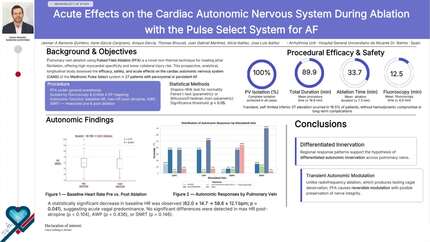
Pulmonary vein ablation using Pulsed Field Ablation (PFA) represents a novel non-thermal technique for the treatment of atrial fibrillation (AF), offering high myocardial specificity and a lower risk of collateral injury. This prospective, analytical, and longitudinal study assessed the efficacy, safety, and acute effects on the cardiac autonomic nervous system (CANS) of the Medtronic Pulse Select system in patients with paroxysmal or persistent AF. Twenty-seven patients underwent PFA under general anesthesia, guided by fluoroscopy and the EnSite X EP electroanatomical mapping system.
Autonomic function was evaluated through baseline heart rate (HR), maximum HR after atropine, anterograde Wenckebach point (AWP), and sinus node recovery time (SNRT), measured before and after ablation. Statistical analyses included descriptive measures, the Shapiro–Wilk test for normality, and parametric (paired t-test) or non-parametric tests (Wilcoxon, Friedman) to compare pre- and post-procedural variables, with p < 0.05 considered significant.
Complete pulmonary vein isolation was achieved in all cases (100%), confirming high procedural efficacy. The mean total duration was 89.9 ± 19.9 min, with a mean ablation time of 33.7 ± 7.3 min and mean fluoroscopy time of 12.5 ± 4.9 min. Transient, self-limited inferior ST elevation occurred in 18.5% of patients, without hemodynamic compromise or long-term complications.
A statistically significant decrease in baseline HR (Figure 1) was observed (62.0 ± 14.7 to 58.6 ± 12.1 bpm; p = 0.041), suggesting an acute vagal predominance. No significant differences were detected in maximum HR after atropine (p = 0.104), AWP (p = 0.436), or SNRT (p = 0.146). Distinct autonomic responses were observed by pulmonary vein (Figure 2): the left superior pulmonary vein (LSPV) elicited bradycardia or asystole in 51.8% of applications, the left inferior vein mainly bradycardia or no response, while the right superior vein triggered sinus tachycardia in 44.4% of cases. The right inferior vein showed minimal autonomic reaction, mostly no response (70.4%).
These findings indicate that PFA with Pulse Select achieves complete pulmonary vein isolation efficiently and safely while inducing acute, reversible modulation of cardiac autonomic tone. The regional pattern of responses supports the hypothesis of differentiated autonomic innervation across pulmonary veins. Unlike radiofrequency ablation, which produces lasting vagal denervation, PFA appears to cause transient autonomic modulation with preservation of nerve integrity. Further multicenter, controlled, and long-term studies are needed to elucidate the persistence and clinical impact of these autonomic effects on AF recurrence and rhythm stability.
Contributors



You may be interested in