Safety of electrocardiogram-asynchronous pulsed-field pulmonary vein isolation: a single-centre cohort analysis
EP Europace Journal


Abstract
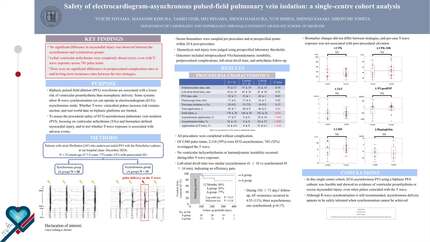
Pulsed field ablation (PFA) catheters, including the PulseSelect™ catheter (Medtronic, MN), employ biphasic pulses, which markedly reduce the risk of ventricular arrhythmias (VA) compared with monophasic waveforms. To further enhance safety, PulseSelect™ enables R-wave synchronization, but also allows pulse delivery in Electrocardiogram (ECG)-asynchronous mode. ECG-asynchronous pulses coinciding with the T wave may theoretically provoke proarrhythmic effects, yet clinical evidence on the safety of ECG-asynchronous PFA remains limited.
To evaluate the procedural safety of ECG-asynchronous pulmonary vein isolation (PVI) using the PulseSelect™ catheter, focusing on the incidence of VA and myocardial injury assessed by serum biomarkers, and to determine whether pulse delivery during the T-wave period is associated with adverse events.
We retrospectively analyzed 35 consecutive patients (mean age 67 ± 9 years; 77% male; 63% paroxysmal atrial fibrillation (AF)) who underwent first-time PVI with PulseSelect™ at Hirosaki University Hospital between June and December 2024. ECG-asynchronous pulses were defined as those delivered without R-wave synchronization. Serum biomarkers (troponin T, CPK, CPK-MB, LDH, haptoglobin, NT-proBNP) were measured before and after ablation. The absence of VA or biochemical evidence of myocardial injury attributable to asynchronous pulse delivery were compared between the ECG-synchronous and ECG-asynchronous groups. Procedure time, AF recurrence, and complications were similarly evaluated.
All procedures were completed without complications. Among 5,940 pulse trains delivered, 2,316 (39%) were ECG-asynchronous, and 745 (32% of ECG-asynchronous) overlapped the T wave. No ventricular tachyarrhythmias or hemodynamic instability occurred during or after T-wave exposure. Biomarker changes did not differ significantly between two groups, and no correlation was observed between T-wave exposure and biomarker elevation. Left atrial dwell time was similar between ECG-asynchronous (41 ± 10 min) and ECG-synchronous groups (45 ± 16 min), indicating no procedural advantage from omitting ECG-synchronization. No complications were observed, and AF recurrence was observed in 4 cases (11%, 3 in the ECG-asynchronous group and 1 in the ECG-synchronous group, p=0.17) during the follow-up period (336 ± 71 days).
ECG-asynchronous PVI using the PulseSelect™ catheter was feasible and safe, with no evidence of arrhythmogenesis or myocardial injury even when pulses coincided with the T wave. The biphasic waveform appears to provide a safety margin during repolarization. While R-wave synchronization remains recommended, asynchronous delivery may be safely tolerated when synchronization is not achievable. Procedural Characteristics Changes in Serum biomarkers

You may be interested in