Early multicentre italian experience with the variable-loop circular catheter pulsed-field ablation system for atrial fibrillation ablation
EP Europace Journal


Abstract
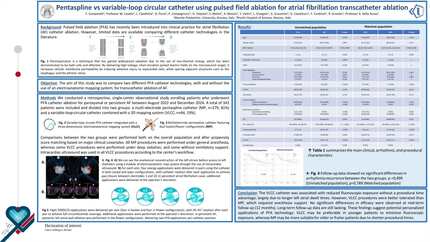
Multiple catheter systems have been developed in the field of cardiac electrophysiology, each featuring distinct technological characteristics. These design differences may substantially impact clinical outcomes, particularly in terms of safety and procedural efficiency. In 2024, a novel integrated pulsed-field ablation (PFA) platform was introduced for atrial fibrillation (AF) ablation.
This registry aimed to assess the early multicentre Italian experience with the variable-loop circular catheter (VLCC), focusing on procedural workflow, safety, and efficiency in AF ablation. The primary endpoint was to evaluate the safety of the new VLCC. Secondary endpoints included measures of procedural efficiency -total procedure time, left atrial (LA) dwell time, mapping time, and fluoroscopy time- and subgroup comparisons between paroxysmal versus persistent AF and pulmonary vein isolation (PVI)-only versus non–PVI-only ablation strategies.
We conducted a retrospective–prospective, observational, multicentre study to describe real-world initial experiences using the PFA VLCC for AF ablation. Nine Italian electrophysiology centres participated. Data from 361 patients undergoing AF ablation with the commercially approved VLCC were analysed for safety, efficacy, and procedural parameters. Comparisons were performed between paroxysmal (n=215) and persistent AF (n=146), and between PVI-only (n=190) and non–PVI-only (n=171) procedures.
Baseline clinical and echocardiographic characteristics are summarized in Table 1. Procedural data for the overall cohort and the subgroups are summarized in Table 2. Among the 361 patients, 8 minor (2%) and 1 major (0.2%) complications were observed. Minor complications included 6 vascular events, 1 coronary spasm, and 1 transient ischemic attack; none required surgical intervention. The major complication was a post-procedural ischemic stroke, likely procedure related. PVI was successfully achieved in all patients, with additional extrapulmonary ablation performed in selected cases. Posterior wall ablation was performed in 120 patients (33%), significantly more often in persistent than in paroxysmal AF (76% vs. 4%; p<0.001). In persistent AF, additional targets included the mitral isthmus, anterior wall, left atrial appendage, superior vena cava, and cavotricuspid isthmus. The total median number of PFA applications was 63 [54–84], higher in persistent than paroxysmal AF (84 [66–105] vs. 57 [54–69]; p<0.001) and in non–PVI-only compared with PVI-only procedures (85 [72–105] vs. 56.5 [51–63]; P<0.001).
In this early multicentre Italian experience, AF ablation using the VLCC PFA platform demonstrated a favourable safety profile and high procedural efficiency across a broad spectrum of clinical settings. These findings support the feasibility and safety of the VLCC system in both paroxysmal and persistent AF, warranting further long-term follow-up. Table_1 Table_2
Contributors

A Dello Russo
Author
G Ciconte
Author
M Schiavone
Author
P Compangucci
Author
A Di Monaco
Author
S Riva
Author
R Salerno
Author
G Volpato
Author
P Mazzone
Author
G Stabile
Author
M Casella
Author
M Grimaldi
Author
C Tondo
Author
C Pappone
Author
You may be interested in