Trends in clinical outcomes and survival following prehospital thrombolytic therapy given by ambulance clinicians for ST-elevation myocardial infarction in rural sub-arctic Norway
European Heart Journal - Acute CardioVascular Care


Abstract
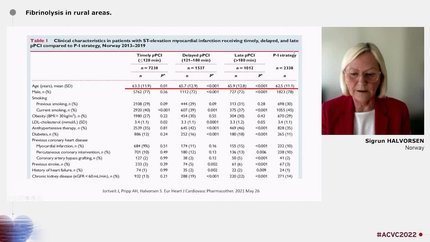
Prehospital thrombolytic therapy given by ambulance emergency medical services to patients with acute ST-segment elevation myocardial infarction (STEMI) may produce earlier reperfusion than percutaneous coronary intervention. Clinical results from prehospital thrombolytic therapy in rural areas are scarce.
We studied outcomes during 11 years of a prehospital thrombolytic therapy system in rural sub-arctic Norway. Ambulance personnel gave protocol basic treatment and transmitted electrocardiograms to hospital physicians who made the decision for prehospital thrombolytic therapy. The study was divided into three time periods; 2000–2003, 2004–2007 and 2008–2011.
A total of 385 STEMI patients received prehospital thrombolytic therapy, median patient age was 61.2 years, and 77% were men. Time saved by prehospital reperfusion therapy was 131 minutes. The proportion who got prehospital thrombolytic therapy within 2 hours of symptom onset increased from 21% in 2000–2003 to 39% in 2008–2011 (
A decentralised prehospital thrombolytic therapy system based on ambulance personnel, telemetry and centralised 7/24 invasive diagnosis and treatment service, combined with system maturation over time, was associated with earlier reperfusion, improved clinical outcomes and better survival. Prehospital thrombolytic therapy is a feasible and safe intervention used in rural settings with long evacuation lines to percutaneous coronary intervention facilities.
Contributors

Terje Steigen
Author
Harald Wang
Author
Pål Morten Tande
Author
Birgitte Mannsverk Dahle
Author
Maret Lajla Nedrejord
Author
Ida Olsen Hokland
Author
Mads Gilbert
Author
You may be interested in