Laryngeal mask ventilation reduces coronary air embolism during cryoballoon ablation for atrial fibrillation: a retrospective comparative study
EP Europace Journal


Abstract
Coronary air embolism is a rare but potentially fatal complication during atrial fibrillation (AF) ablation, particularly when large-bore sheaths are used. Respiratory instability and negative intrathoracic pressure under deep sedation may facilitate air intrusion. This study evaluated whether airway management using a laryngeal mask (LM) with positive-pressure ventilation could reduce air embolism compared with adaptive servo-ventilation (ASV) during cryoballoon ablation (CBA).
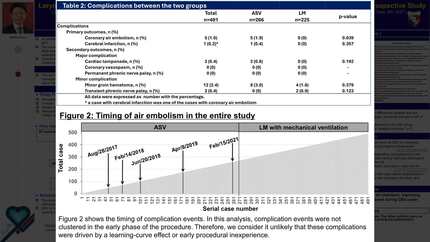
We retrospectively analyzed consecutive patients who underwent CBA for AF at our University Hospital between January 2017 and June 2024. Patients were categorized according to respiratory management: ASV (n = 266) or LM with mechanical ventilation (n = 225). Baseline characteristics, procedural details, and complication rates were compared. The primary endpoint was the incidence of coronary or cerebral air embolism; secondary endpoints included all peri-procedural complications within 30 days.
Among 491 patients (median age 68 years, 71.3% male), baseline clinical variables were generally comparable between groups except for AF type and left ventricular ejection fraction. Symptomatic coronary air embolism occurred in 5 patients (1.9%) in the ASV group and in none of the LM group (p = 0.0387). No cerebral embolism or deaths occurred. Other complications included two cases of cardiac tamponade (ASV) and two transient phrenic nerve palsies (LM) without significant differences. Positive-pressure ventilation using LM effectively prevented negative intrathoracic pressure and possible air intrusion through large-bore sheaths.
Airway management with a laryngeal mask and mechanical ventilation markedly reduced coronary air embolism during CBA compared with ASV. These results emphasize that respiratory control is a crucial determinant of procedural safety in large-bore sheath–based ablation techniques and support the wider use of LM ventilation for high-risk patients.
Contributors



You may be interested in