A multi-center study comparing leadless pacemaker vs. standard pacemaker in patients with indication to ablate and pace for atrial fibrillation (LEAD-AP)
EP Europace Journal


Abstract
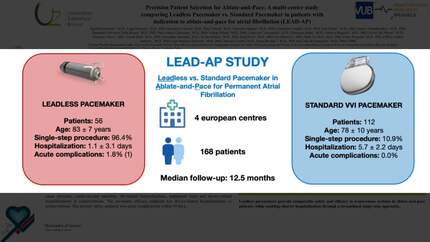
In patients with symptomatic permanent atrial fibrillation (AF) who are not candidates for rhythm control, atrioventricular node (AVN) ablation followed by ventricular pacing "ablate-and-pace" offers reliable rate control and symptom relief. Conventional transvenous systems are effective but associated with lead- and pocket-related complications. Leadless pacemakers represent a promising alternative, yet comparative data in this setting remain scarce. The aim is to compare clinical outcomes of leadless versus transvenous single-chamber pacemakers in patients undergoing AVN ablation for permanent AF.
We conducted a retrospective, multicenter study (LEAD-AP) of 168 consecutive patients undergoing ablate-and-pace between 2017 and 2024 across four European centers. Patients received either a leadless pacemaker (n=56) or a conventional transvenous VVI pacemaker (n=112). The primary efficacy endpoint was the composite of all-cause mortality, cardiovascular mortality, AF-related hospitalizations, unplanned visits and device-related hospitalizations or reinterventions. The secondary efficacy endpoint was device-related hospitalizations or reinterventions. The primary safety endpoint was acute complications within 30 days.
Patients in the leadless group more frequently underwent a single-step ablate-and-pace strategy (96.4% vs 10.9%, p<0.001), resulting in shorter hospitalization (1.1 days ± 3.1 vs 5.7 days ± 2.2, p=0.008). At 24 months of follow-up, there was no statistically significant difference between patients with leadless pacemaker vs standard single-chamber VVI pacemaker in the event-free survival for the primary clinical efficacy endpoint (82.1 % vs 80.4 % Log-Rank p = 0.29), Figure 1 and 2.
Leadless pacemakers provide comparable safety and efficacy to transvenous systems in ablate-and-pace patients, while enabling shorter hospitalization through a streamlined single-step approach.
Contributors

I Overeinder
Author
L Pannone
Author
W Zaher
Author
G Mugnai
Author
G Arabia
Author
D G Della Rocca
Author
G Bala
Author
A Almorad
Author
E Stroker
Author
J Sieira
Author
A Sarkozy
Author
G B Chierchia
Author
A Curnis
Author
S Boveda
Author

You may be interested in