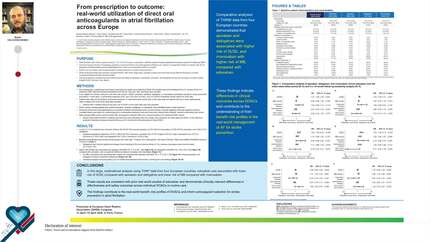
From prescription to outcome: real-world utilization of direct oral anticoagulants in atrial fibrillation across Europe
EP Europace Journal


Abstract
Direct oral anticoagulants (DOACs) are widely used for stroke prevention in atrial fibrillation (AF). While randomized trials have primarily compared DOACs with vitamin K antagonists, large scale, population-based real-world data across different European countries comparing individual DOACs remains limited.
This study aimed to evaluate real-world effectiveness and safety of apixaban, rivaroxaban, edoxaban, and dabigatran across four European countries (United Kingdom, Germany, Italy, Spain).
This retrospective, multinational cohort study used data from THIN (The Health Improvement Network). Adults with nonvalvular AF initiating a DOAC between 01/01/2016—31/12/2024 were included. Patients with prior DOAC use, venous thromboembolism, mechanical heart valves, or recent major surgery were excluded. Primary outcomes were ischemic stroke/systemic embolism (IS/SE) and major bleeding (MB), defined as intracranial hemorrhage, gastrointestinal bleeding, or bleeding into other critical sites. Propensity scores were calculated based on covariates of patient characteristics and a country indicator, and overlap weighting (OW) was subsequently applied to balance baseline characteristics. Hazard ratios (HRs) and 95% confidence intervals (CIs) were estimated using Cox models, with edoxaban, the latest approved DOAC, as the reference treatment. Sensitivity analyses censored follow-up at 12 months.
A total of 113,473 patients were included (apixaban 57.4%; rivaroxaban 20.4%; edoxaban 19.0%; dabigatran 3.1%). Baseline characteristics were similar across groups, with mean age ~75 years and ~55% male (Table 1). Mean CHA2DS2-VASc and modified HAS-BLED scores were 2.5 and 2.3. Dabigatran users had the highest percentage of prior bleeding (4.5%) and ischemic stroke (3.1%), whereas rivaroxaban users had the lowest (2.7% and 1.3%). Higher risk of IS/SE was associated with apixaban (HR [95% CI]: 1.21 [1.08–1.36]) and dabigatran (HR [95% CI]: 1.63 [1.30–2.04]) compared with edoxaban, with no significant difference between edoxaban and rivaroxaban. For MB, rivaroxaban was associated with a higher risk compared with edoxaban (HR [95% CI]: 1.17 [1.03–1.33], whereas apixaban and dabigatran showed no significant differences (Table 2). Sensitivity analyses demonstrated similar trends, confirming the main findings.
In this large, multinational analysis using real-world data from four European countries, edoxaban was associated with lower risk of IS/SE compared with apixaban and dabigatran and lower risk of MB compared with rivaroxaban. These findings indicate differences in clinical outcomes across DOACs, and contribute to the understanding of their benefit–risk profiles in the real-world management of AF for stroke prevention. Baseline Characteristics Hazard ratios for MB and IS/SE
Contributors


R Wang
Author
C Paris
Author
C Eteve-Pitsaer
Author
C Chen
Author
M Unverdorben
Author
X Ye
Author
S Jawla
Author
C Becker
Author
B Brueggenjuergen
Author
You may be interested in