Patients with high thromboembolic risk undergoing left atrial appendage closure
EP Europace Journal


Abstract
Left atrial appendage closure (LAAC) is an alternative treatment option in atrial fibrillation (AF) patients with contraindication, intolerance or inefficacy of oral anticoagulation (OAC). There is currently limited evidence about patients with high thromboembolic risk undergoing LAAC compared to remaining patients.
A retrospective analysis from a multicentre registry including consecutive patients undergoing LAAC was performed, investigating in baseline and outcome differences between patients with high thromboembolic risk (defined as CHA2DS2-VA score > 4, "high-risk") and remaining patients. Major short-term complications were defined as any complication necessitating an invasive intervention, or death.
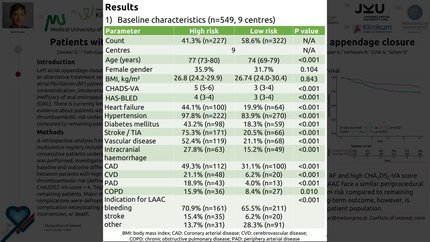
A total of 549 patients from 9 centres were included. Median age was 76 (interquartile range 70-80) years and 35.9% were female. High-risk patients with were older (median 77 vs. 74 years, p<0.001) and had a substantially higher risk profile with a higher prevalence of heart failure (44.1% vs. 19.9%, hypertension (97.8% vs. 83.9%), diabetes (43.2% vs. 18.3%), stroke (75.3% vs. 20.5%), vascular disease (52.4% vs. 21.1%), abnormal renal function (31.7% vs. 18.0%, p<0.001 for all), as well as ischaemic haemorrhage (27.8% vs. 15.2%), chronic obstructive pulmonary disease (15.9% vs. 8.4%), and hyperlipidaemia (40.5% vs. 30.7%, p<0.05 for all). Still, major complications were similar in both groups (5.7% vs. 4.0%, p=0.417) and 30-day survival was even better in the high-risk group (cumulative survival 100% vs. 92.2%, p=0.021). Long-term survival, however, was significantly reduced in the high-risk patients (cumulative 5-year survival, 73.1% vs. 83.5%, p=0.002).
Patients with AF and high CHA2DS2-VA score undergoing LAAC face a similar periprocedural and short-term risk compared to remaining patients. Long-term outcome, however, is worse in this patient population.
Contributors




You may be interested in