Dynamical signatures of entropy mechanistically differentiate paroxysmal and non-paroxysmal atrial fibrillation
EP Europace Journal


Abstract
Information theoretical properties have long been suggested to be important for understanding Atrial fibrillation (AF) complex system dynamics and may be mechanistically related to the emerging concept of spatiotemporal electrogram dispersion. However, despite this potential, no large-scale systematic studies of dynamical properties of entropy in AF have been performed.
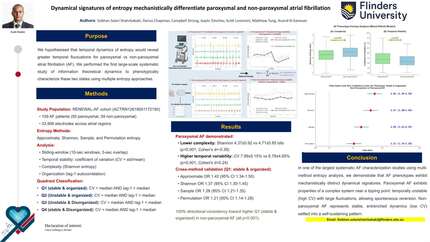
We hypothesised that temporal dynamics of entropy would reveal greater temporal fluctuations for paroxysmal and non-paroxysmal AF. We therefore performed the first large-scale systematic study of information theoretical dynamics to phenotypically characterize these two states using multiple entropy approaches.
From the RENEWAL-AF cohort, 109 AF patients (50 paroxysmal, 59 non-paroxysmal) contributed 33,906 electrodes across atrial regions. Sliding-window analysis (10-second windows, 5-second overlap) assessed temporal stability (coefficient of variation), complexity (Shannon entropy), and organization (lag-1 autocorrelation). Four entropy method including approximate, Shannon, sample and permutation were used to characterize electrogram complexity. Quadrant analysis: Q1 (stable & organized; CV< median AND lag-1> median), Q2 (unstable & organized; CV> median AND lag-1> median), Q3 (unstable & disorganized; CV> median AND lag-1< median) and Q4 (stable & disorganized; CV< median AND lag-1< median). Logistic regression assessed odds ratios (OR) for Q1 prevalence across all four independent entropy methods.
Paroxysmal AF demonstrated significantly lower complexity (Shannon entropy: 4.37±0.92 vs 4.71±0.85 bits; p<0.001; Cohen's d=-0.39), but higher temporal variability (CV: 7.99±5.15% vs 6.79±4.65%; p<0.001; Cohen's d=0.24), suggesting high temporal fluctuations of relatively organized electrical activity. Cross-method Q1 validation revealed remarkable consistency: approximate entropy OR 1.37 (95% CI 1.30–1.45), Shannon entropy OR 1.37 (1.30–1.45), sample entropy OR 1.28 (1.21–1.35), permutation entropy OR 1.21 (1.14–1.28), all with p<0.001. All four methods exhibited 100% directional consistency toward higher Q1 in non-paroxysmal compared to paroxysmal AF. This multi-method validation reproducibility confirms mechanistic differences in electrical dynamics between AF phenotypes, with non-paroxysmal AF representing stable, entrenched patterns.
In one of the largest ever studies to perform systematic AF characterisation through multi-method entropy analysis, we demonstrate that AF types exhibit mechanistically distinct dynamical signatures. Paroxysmal AF exhibits properties of a complex system near to a tipping point: it is temporally unstable (high CV) and exhibits large fluctuations, characteristic of a "tipping point" state allowing spontaneously reversion. In contrast, non-paroxysmal AF represents more stable, entrenched dynamics (low CV) that has settled into a more stable, self-sustaining pattern. AF phenotype entropy analysis Entropy forestplot
Contributors

D Chapman
Author
C Strong
Author
I Tonchev
Author
S Lorensini
Author
M Tung
Author
A N Ganesan
Author
You may be interested in